


TACTICAL ANALYSIS : Wydad's structural superiority that troubled Nairobi United







Reading Time: 6min | Mon. 24.11.25. | 22:00
The 3–0 scoreline accurately reflected the gulf in tactical execution, composure, and efficiency between the two sides on the day
Two years ago, in a far-flung pitch in Kagumori Grounds in Eastern Kenya, Nairobi United lost 2-1 to 3K FC, ending a 13-match unbeaten run in Kenya's third tier of football.
It would take them two years to scale the heights of the FKF Premier League, where they became only the second side after Mathare United to represent the country in continental football after coming from the second tier.
Follow our WhatsApp channel for more news
Fast forward, and now they are rubbing shoulders with the elite of African football from the three-time CAF Champions League winners Wydad to Tanzanian giants Azam FC and Congolese bigwigs AS Maniema.
In their first group outing, the Naibois headed to Casablanca, Morocco, in a David vs Goliath battle.
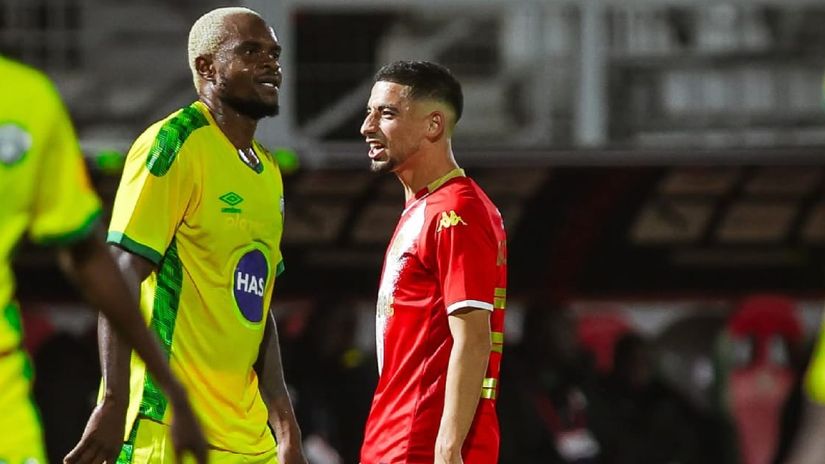
The Nairobi-based club opened their CAF Confederation Cup outing with a 3-0 loss to Wydad Athletic Club, a result built on structural superiority, territory control, and well-coordinated attacking patterns, depicted by the hosts.
From kickoff, Wydad imposed their identity, operating in a 4-3-3 organisational structure that allowed them to dictate tempo and shape the flow of the match.
With Benabid El Mehdi in goal, the back four consisted of Ayoub Boucheta on the right, Mohamed Bouchouari on the left, and the centre-back pairing of Guilherme Ferreira and Bart Meijers.
Their double pivot of Lamirat Abdelghafour and Joseph Bakasu played an essential role in stabilising build-up, recycling possession, and protecting rest defence, while the more advanced midfielder, Aziz Ki, floated intelligently into half-spaces, dropped deep when needed, and linked play across all attacking channels.

The forward line - Amrabat Noordin on the right, Thembinkosi Lorch on the left, and Hamza Hannouri centrally - offered a blend of width, penetration, and combination play.
Nairobi United, meanwhile, approached the match in a 4-4-2 structure, demonstrating a clear plan to remain compact, absorb pressure, and break forward rapidly.
Kevin Oduor started in goal behind a defensive line of Prince Buregeya, Kevin Osanya, Lennox Ogguttu, and John Otieno.
Their midfield saw Brian Omondi and Lesley Owino as the central double pivot, with Shami Mwinyi and Omalla Dancan operating wide.
In their attacking transitions, Enock Machaka floated just behind striker Michael Karamor, operating as the advanced link player in a narrow role.

Nairobi’s plan relied greatly on quick vertical breaks - most often targeting the right channel - and the ability of Karamor to contest aerial duels and provide hold-up moments.
The match, however, immediately tilted in Wydad’s favour.
Just three minutes in, Ayoub Boucheta scored with a low-driven strike after drifting inside the box from the left flank.
That early setback forced Nairobi United into deeper defensive phases, and although they remained committed to a hybrid defensive scheme - using zonal markers at set pieces, a compact 4-4-2 mid-block without the ball, and long goal kicks to bypass Wydad’s press - the pressure quickly mounted.
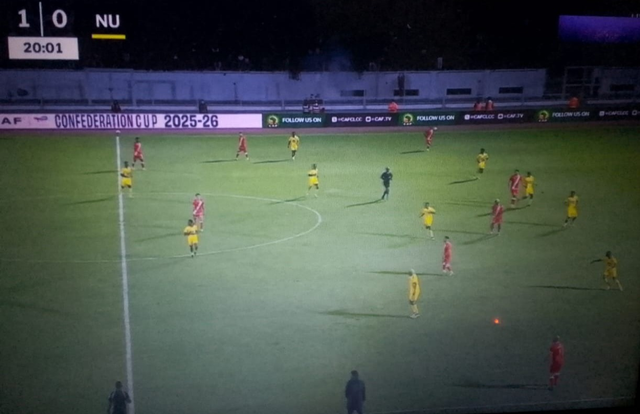 Nairobi initially defended in a compact 4-4-2 out of possession, closing central lanes and trying to regain the ball through a tight mid-block structure.
Wydad maintained a 4-1-3-2 structure out of possession, pressing aggressively with their front players and closing Nairobi’s central progression lanes.
This disrupted Nairobi’s ability to maintain sequences of possession, with their midfielders often forced to clear second balls or surrender the ball under pressure.
Wydad’s dominance on the wings proved decisive. Their right flank, with Amrabat operating deeper during transitions and fullback Bouchouari pushing extremely high, became a constant source of ball progression.
Amrabat, a former Watford FC forward, frequently delivered switches, crosses, and cut-backs, while on the right flank, Boucheta and Lorch combined through tighter half-space interactions on the left.
In central areas, the double pivot of Lamirat and Bakasu stayed disciplined, enabling the fullbacks to maintain advanced positions and ensuring the centre-backs always had sufficient rest defense against potential counters.
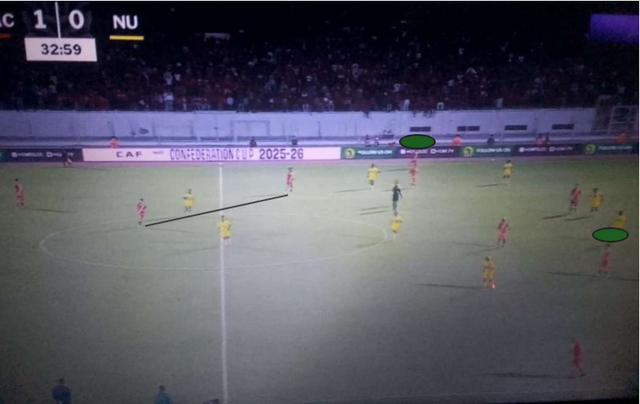 Lamirat and Bakasu’s disciplined double pivot provided stability in central areas, allowing the fullbacks to push high while maintaining strong rest defence with the centre-backs.
With Nairobi’s centre-backs often stepping out aggressively to block half-space entries, Wydad manipulated their shape well, dragging defenders out of position and exploiting the gaps created.
Wydad’s second goal, scored by their left-back Bouchouari just before halftime, reflected their territorial dominance.
After a ricochet outside Nairobi’s box, he unleashed a powerful strike from the right channel, doubling the lead at a psychologically crucial moment.
Nairobi, who had spent extended spells pinned in their own half, struggled to carry numbers forward in transitions.
Each time they regained possession, they often lost it within seconds due to poor spacing and the inability to connect midfield to attack.
With Wydad overloading both wide zones, stretching Nairobi horizontally, and rotating intelligently around Aziz Ki, the visitors were consistently forced into reactive defending.
The second half continued with the same pattern, Wydad pinning Nairobi deep and forcing them into a defensive 5-4-1 low block as the Kenyan side dropped the left winger, Shami Mwinyi, tracking Wydad’s fullback, into the back line for added protection.
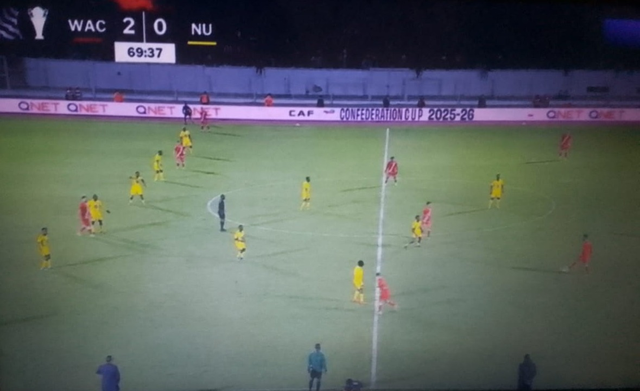 Nairobi shifted into a 5-4-1 block, with Shami Mwinyi dropping into the last line to track Wydad’s right-back, while Karamor stayed high as the lone outlet in the first line of attack
Nairobi struggled to maintain control in midfield, frequently ceding possession immediately after recovering it.
Their attempt to use third-man runs on the left flank yielded brief moments of promise, but their transitions lacked precision and sufficient attacking numbers.
Goal kicks continued to target Karamor, who attempted to hold the ball up and involve midfielders, but Wydad’s centre-backs stepped in efficiently to win duels and prevent Nairobi from building rhythm.
Both teams used lateral passes as pressing cues, but Wydad executed their high press and wing traps far more effectively.
Their ability to form third-man combinations and passing triangles on the wings - particularly on the left side - eventually led to their third goal. In the 86th minute, substitutes Sabbar and Mohamed Rahyi combined brilliantly on the flank, slicing through Nairobi’s tired defensive line.
With the goalkeeper rushing out, Rahyi kept his composure and chipped the ball over him with his left foot to seal a comprehensive 3–0 victory.
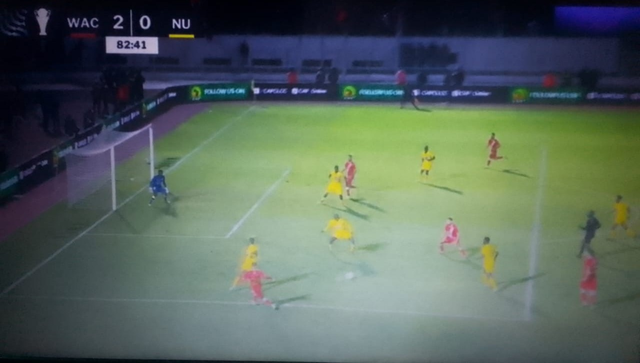 Wydad’s sharp third-man combinations and passing triangles on the left flank created constant overloads, stretching Nairobi’s defensive shape as the advancing fullback joined through well-timed overlapping runs
In the closing minutes, Nairobi attempted to press high and force errors from Wydad’s structured build-up, but their late aggression came too late to influence the match.
Wydad’s patience in possession, technical security, and intelligently coordinated attacking rotations ensured they remained in control until the final whistle.
Overall, Wydad showcased a well-drilled tactical system, strong spatial occupation, and clear superiority in wide areas - all of which Nairobi United struggled to cope with.
The Moroccan side’s blend of controlled build-up, wing-based overloads, and disciplined rest defence made the difference in a match where Nairobi United spent long periods defending and rarely threatened in open play.
The 3–0 scoreline accurately reflected the gulf in tactical execution, composure, and efficiency between the two sides on the day.