


TACTICAL ANALYSIS: Kenya U20's brilliant game plan against Morocco




.jpg)
Reading Time: 4min | Fri. 02.05.25. | 17:40
Morocco sustained pressure—particularly down the flanks—a move that proved decisive
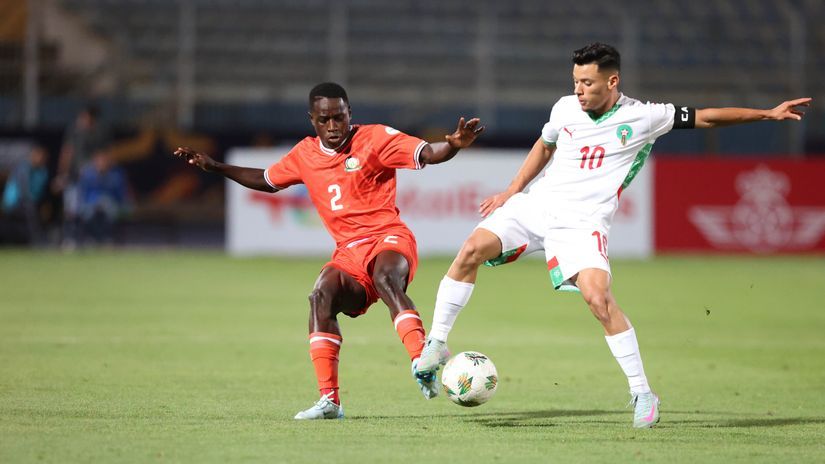
Kenya U20’s long-held dream of competing at a continental stage finally came to life, and while the Rising Stars fell 3-2 to Morocco in their AFCON U20 Group B opener, the boys showed grit and flashes of brilliance that kept the Atlas Lions on edge.
Follow Our WhatsApp Channel For More News
This was a match shaped as much by tactics as it was by individual moments. Kenya took the lead early, only for Morocco to equalize on the stroke of halftime. The North Africans then edged ahead after the break, Kenya clawed back, and Morocco restored their lead for good with 15 minutes to play.
In the end, Morocco’s sustained pressure—particularly down the flanks—proved decisive.
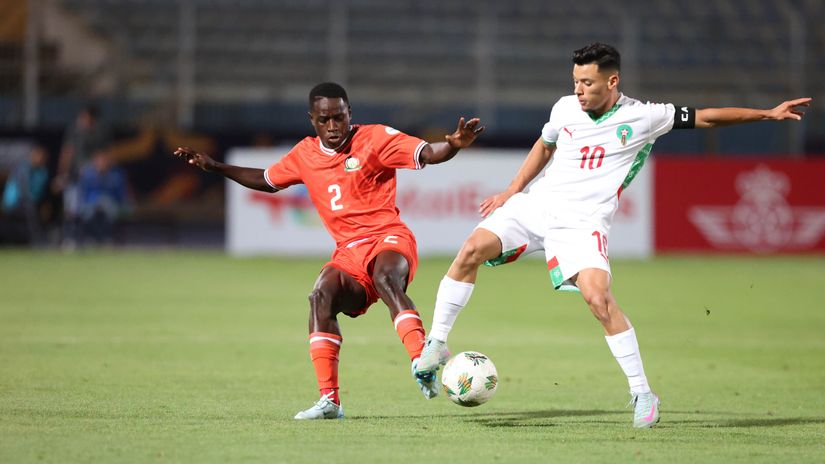
Kenya's Game Plan: Absorb, Counter, and Exploit Width
Salim Babu set up his side in the familiar 4-2-3-1, with Benard Jairo in goal behind a backline of Collins Ochieng, Baron Ochieng, Manzur Okwaro, and Amos Wanjala.
Andreas Odhiambo and Kelvin Wangaya anchored the midfield, with Aldrine Kibet operating as the creative spark. Hassan Beja and Elly Owande started wide, while Lawrence 'Olunga' Ouma led the line.
Kenya’s approach was clear: cede possession, defend deep, and hit on the counter. In possession, they aimed to build from the back with Okwaro and Wanjala splitting wide while Jairo started the build up. The center-backs would feed Wangaya or Odhiambo, who would then find the wide players in space to initiate forward drives.
The wide areas were key in Kenya’s offensive strategy. The fullbacks pushed forward frequently to support overlapping runs, with wingers tucking in to create space. This worked well in moments, especially when Collins Ochieng overlapped effectively—his forward run led to the free-kick from which Kenya opened the scoring.
But this approach came with risks. With both fullbacks committing forward, the Rising Stars were often left exposed in transition. Morocco exploited these spaces ruthlessly with quick switches and targeted wing play, especially down Kenya’s right.
Morocco’s Strategy: Wide Overloads and Wing Isolation
Mohamed Ouahbi deployed Morocco in a 4-2-3-1 as well, with a heavy emphasis on wide attacks and positional overloads. The Atlas Lions regularly bypassed Kenya’s central press by stretching the field and creating triangles out wide.
Their attacking midfielder, Saad El Haddad, often drifted into wide areas to combine with wingers and fullbacks, creating 3v2 situations that Kenya struggled to contain.
Central to this wing-focused strategy was Othmane Maamma, who roamed both flanks and relentlessly attacked Kenyan fullbacks in 1v1 situations. His ability to glide past defenders with ease made him Morocco’s most dangerous outlet, especially when settled buildup slowed.
Kenya attempted to defend in a compact 4-4-2 out of possession, with Kibet and Ouma marking Morocco’s midfield pivots, Reda Laalaoui and Amine Boukamir, to deny central progression. While this stifled Morocco’s build-up initially, the Atlas Lions simply shifted focus wide where Kenya was most vulnerable.
It was in these spaces that Maamma thrived. His burst of pace and close control saw him consistently beat Ochieng. The second goal was born from this matchup—Maamma twisted past Ochieng and delivered a pinpoint cross for Yassir Zabiri to head home.
Substitutions and Sustained Pressure
The second goal prompted Babu to make changes—Ochieng was substituted, with Humphrey Kegengo coming in at right back and Baron Ochieng switching to the left. But Maamma’s influence didn’t wane.
The winger simply maintained his output and found joy once more, this time roasting Baron Ochieng for pace before delivering a dangerous cross that led to Morocco’s third goal.
This sequence highlighted a key issue: Kenya didn't just need a personnel change—they needed a tactical solution to deal with Maamma. Tracking his movement, doubling up defensively, or cutting off supply earlier in midfield could have helped, but those adjustments never came.
Tactical Chess, Individual Brilliance
Both coaches approached the game with clear strategies. Coach Babu sought to absorb pressure and punish Morocco on the counter, relying on overlapping fullbacks and wide transitions. Ouahbi, meanwhile, leaned into Morocco’s technical superiority, orchestrating attacks through wide overloads and isolations.
While Kenya’s resilience and attacking intent were commendable, it was Morocco’s wing play that proved the difference, with Othmane Maamma emerging as the X-factor.
His presence ensured Morocco had the edge in moments where tactical systems alone weren’t enough—reminding everyone that sometimes, individual brilliance can tip the balance in a finely poised match.