


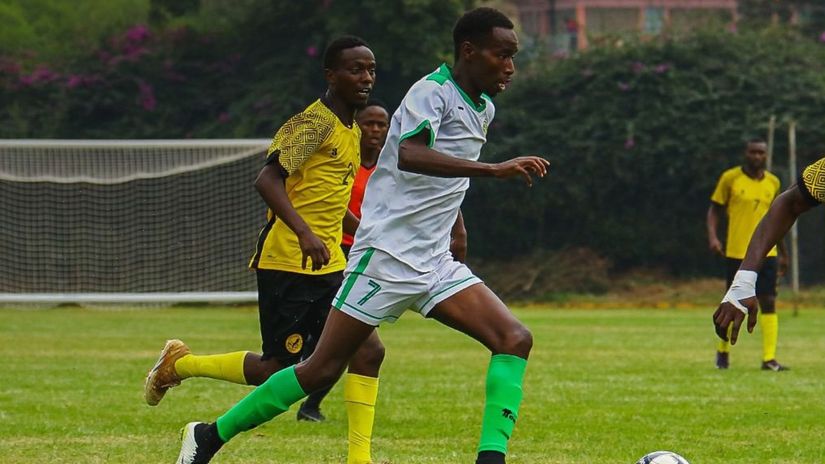
TACTICAL ANALYSIS: Kariobangi Sharks' tactical maturity that overpowered Sofapaka in Elite Cup tie






Reading Time: 4min | Wed. 03.09.25. | 20:37
Sharks’ tactical flexibility was evident throughout with their ability to switch from wide overloads to central penetration, coupled with Razel’s flair, overwhelmed Sofapaka
In yesterday’s Elite Pre-Season Cup clash, Kariobangi Sharks defeated Sofapaka 3-1 in a match that showcased tactical depth and adaptability.
Follow our WhatsApp channel for more news
Sharks dominated possession with a patient, possession-based approach, while Sofapaka relied on a compact defensive structure and quick transitions.
Sharks’ ability to exploit wide areas and adapt to Sofapaka’s adjustments proved decisive, offering a glimpse into their pre-season preparedness.
From the outset, Kariobangi Sharks controlled the game through a 3-2-4-1 formation, emphasising build-up from the back.
Their goalkeeper acted as an extra outfielder, creating numerical superiority in the first phase of play.
This allowed Sharks to circulate the ball confidently, drawing Sofapaka’s press and finding spaces. Humphrey Aroko, the attacking midfielder, was central, dropping between the lines to receive and progress play.
His positioning disrupted Sofapaka’s midfield, enabling quick transitions into attack.
Sharks focused on wide areas, particularly the right, using triangles involving the right-back, winger, and Aroko to create overloads, with constantly attempted switches from midfield.
Positional shapes: Sharks in a 3-2-4-1 against Sofapaka’s 4-1-3-2 out of possession
Sofapaka countered with a 4-4-2 diamond midfield out of possession, employing a high defensive line to compress space and catch Sharks’ forwards offside, a tactic effective by the half hour mark.
Their strategy funneled Sharks’ play wide, where they defended robustly.
However, Sharks’ persistent right-sided attacks, orchestrated by Aroko’s link-up play, tested Sofapaka’s resolve.
Defensively, Sharks used a 5-3-2 high block to press Sofapaka’s build-up, forcing them to go long.
Sharks’ centre-back Luke Otiala excelled, intercepting aerial balls, neutralising Sofapaka’s right-sided transitions from their goalkeeper.
Both teams’ high lines led to proactive goalkeeping, with keepers sweeping outside their boxes.
Set pieces revealed tactical contrasts: Sharks opted for short corners to recycle possession and target second balls, while Sofapaka used a hybrid man-marking system with one zonal marker at the front post.
Sharks’ attacks grew more direct as the half progressed, with long balls bypassing Sofapaka’s structured press, indicating frustration with limited central penetration.
Sofapaka attempted quick transitions but faltered against Sharks’ organized recovery, bolstered by Omotto dropping deep alongside the centre-backs for progression.
Around the 40th minute, Razel Omondi switched to the right flank, creating overloads with the winger and right-back, disorienting Sofapaka’s defense.
Despite Sharks’ possession dominance, the half ended 0-0, highlighting Sofapaka’s defensive resilience and Sharks’ need for sharper finishing.
The second half saw Sharks shift to a 4-2-4 midblock, maintaining a high press while stretching Sofapaka horizontally.
Razel, now on the left, drew a foul in the 46th minute, linking with the overlapping left-back to exploit the flank.
Sharks’ third-man combinations by the 51st minute evaded pressure and pulled Sofapaka’s defense apart. Sofapaka capitalised on a defensive lapse in the 49th minute, but their shot went wide, underscoring missed opportunities in transition.
The breakthrough came in the 52nd minute when a right-sided cross was punched by Sofapaka’s goalkeeper, allowing Victor Ngume to score from the rebound, giving Sharks a 1-0 lead.

This goal stemmed from their persistent wide overloads. Two minutes later, Sofapaka earned a penalty after Sharks’ right center-back fouled their forward. Beckam Omondi converted, leveling the score at 1-1.
Sofapaka adopted a 4-2-4 high block to disrupt Sharks’ deep build-up, seeking quick transitions but struggling with poor final-third passes.
The game’s turning point arrived in the 68th minute. Razel, receiving on the left, dribbled infield and was fouled in the box, earning a penalty.
Mark Vivian Kesa converted calmly, sending the goalkeeper the wrong way to make it 2-1. A minute later, Razel drove into space, cut inside, and assisted Zablon Kutela, whose slight touch deflected past the keeper for a 3-1 lead.
These rapid goals exposed Sofapaka’s vulnerability to individual brilliance and quick flank combinations.
Sofapaka’s challenge intensified when one of their players was red-carded, reducing them to 10 men.
They shifted to a 5-4-0 midblock, prioritizing compactness. Sharks adapted, transitioning to a 3-2-5 shape in attack with high ball recycling to probe for gaps.

Sofapaka’s low block held until the 78th minute, with Sharks’ central progression earning a free-kick just outside the box in the 80th minute, though it was fired wide.
Structural matchup: Sharks in a 3-2-5 against Sofapaka’s 5-4-0 defensive block
Sharks’ tactical flexibility was evident throughout with their ability to switch from wide overloads to central penetration, coupled with Razel’s flair, overwhelmed Sofapaka.
The red card tilted the balance, but Sofapaka’s disciplined defending prevented further damage. Sharks’ possession dominance was underpinned by key players: Aroko in build-up, Otiala in defense, and Razel in attack.
This 3-1 victory highlights Sharks’ tactical maturity. Their 3-2-4-1, evolving into aggressive shapes, facilitated control and effective flank play. Sofapaka’s 4-1-3-2/4-4-2 diamond offered resilience but lacked precision in transitions, worsened by errors and the red card.
Both teams’ high lines invited risks, with goalkeepers playing pivotal roles. Sharks’ use of their goalkeeper in build-up and overload creation marks them as progressive, while Sofapaka must refine pressing triggers and final-third decision-making.
This pre-season encounter underscores that adaptability and execution in key moments define success. Sharks appear primed for the season, while Sofapaka will look to address defensive lapses.