



TACTICAL ANALYSIS: How Azam FC outsmarted Nairobi United to secure maiden CAF CC win








Reading Time: 7min | Tue. 27.01.26. | 22:00
Nairobi United showed promise, especially in transition and pressing discipline, but Azam’s superior positional play, adaptability, and composure in critical moments proved decisive
One-time Tanzanian Premier League champions Azam FC secured a 2–1 victory over Nairobi United in a CAF Confederation Cup Group B clash on Sunday, 25 January.
Follow our WhatsApp channel for more news
From the opening exchanges, the encounter pointed towards a game where tactical discipline would outweigh volume of possession.
The interaction between Nairobi United’s pressing schemes and Azam’s build-up adaptations framed a match decided by decision-making, spacing, and execution in decisive phases.
Nairobi United began the contest in a 4-1-2-3 organisational structure that prioritised vertical compactness and direct progression.
Ernest Mohammed operated behind a back four of Yusuf Mainge (right-back), Kevin Osanya (left-back), and the central pairing of Lennox Ogutu and John Otieno.
Roy Okal anchored midfield as the single pivot, tasked with screening the backline and offering stability in early build-up.
Ahead of him, Lesley Owino and Enock Machaka formed a staggered central midfield, with Owino closer to the base and Machaka given license to advance.
Ovella Ochieng and Dancun Omalla held width on either flank, supporting Michael Karamor as the central striker.
Azam, meanwhile, lined up in a flexible 4-3-3 that frequently resembled a 4-2-1-3 in possession.
Zuberi Foba started in goal, protected by Lusajo Mwaikenda at right-back, Pascal Msindo at left-back, and Lawi Lameck alongside Yoro Diaby centrally.
Zayd Yahya and Himid Mao Mkami formed a double pivot, while Feisal Salum operated ahead of them as the advanced midfielder.
Diakite Cheickna and Iddi Nado occupied the wide roles, with Jephte Kitambala functioning as the reference point in attack.

Azam’s out-of-possession approach in the first half was built around an aggressive high press, designed to disrupt Nairobi United’s rhythm early. However, this press was deliberately asymmetric.
While Azam committed numbers to the first line, Iddi Nado maintained a slightly withdrawn position on the right, leaving Nairobi’s left side temporarily open.
This was not an oversight but a calculated risk, intended to funnel Nairobi’s build-up toward less progressive options or force them into long passes.
The logic behind this press was twofold. First, Azam wanted to provoke direct play from Nairobi, which would allow Kitambala to compete for second balls.
Second, by keeping Nado slightly detached, Azam preserved horizontal compactness in central areas, limiting access to Machaka between the lines.
The downside was space for Osanya, but Azam trusted their rest-defence to manage that risk.
Nairobi United, for their part, attempted to counter with a high press of their own, led by Machaka and Karamor.
Their pressing triggers were primarily ball-oriented - engaging aggressively when the ball travelled wide or when Azam’s full-backs received facing their own goal.
However, this press lacked sustained coordination, particularly when Zayd Yahya dropped between the centre-backs, and Foba stepped forward as an extra outfielder, creating a numerical advantage in the first line.
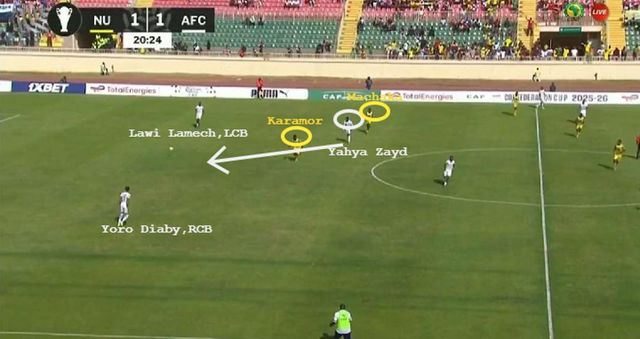
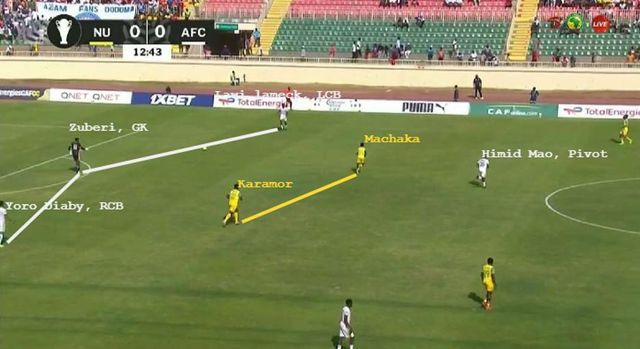 In possession, Azam’s build-up was methodical and structurally sound. Zayd and Himid regularly dropped close to the centre-backs, forming a temporary back three that allowed both full-backs to advance.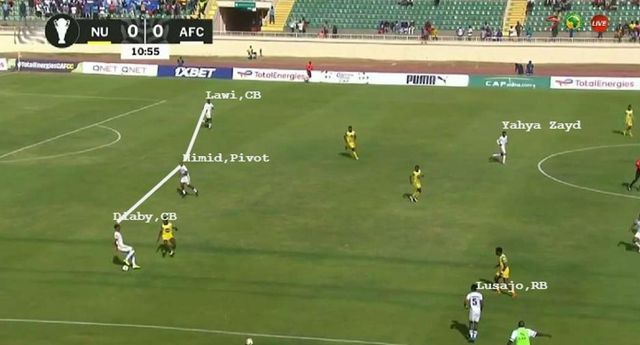
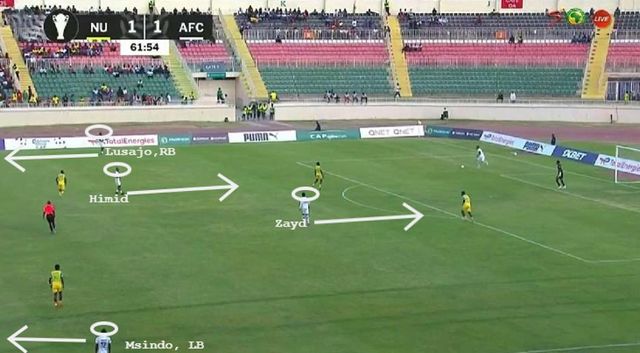
This shape created overloads against Nairobi’s first pressing line and forced their forwards into difficult decisions - step out and leave space behind, or hold shape and concede progression.
Nairobi United responded by adjusting their midfield roles. Lesley Owino frequently dropped to assist in build-up, particularly on the right side.
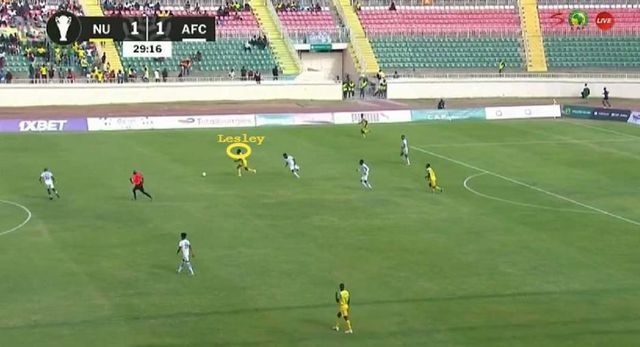
This movement was crucial in bypassing Azam’s first line of pressure and accessing Ovella Ochieng in wide areas. Nairobi’s attacking emphasis quickly became clear: long diagonal balls toward the right flank, using Ovella Ochieng’s pace and directness to accelerate play and avoid central congestion.
This approach paid dividends in the 14th minute. A forced turnover high up the pitch, triggered by Karamor’s pressure, allowed Dancun Omala to strike first time over a goalkeeper positioned off his line.
The goal was not the result of sustained pressure but of a momentary breakdown in Azam’s rest-defence - a reminder of the risks inherent in their aggressive positioning.
Azam’s response was immediate and ruthless. Just three minutes later, Nairobi United were punished for a critical error in their own build-up.

Ernest Mohammed’s unsuccessful throw-out handed possession straight back to Azam, and after a blocked shot from Yoro Diaby, Kitambala capitalised with a sharp turn and emphatic finish inside the box.
This sequence highlighted a recurring theme: Azam did not need prolonged spells of dominance to create danger; they needed Nairobi United to lose structure for even a moment.
From that point, Azam increasingly leaned on Kitambala’s ability to serve as both a target and a connector.
He dropped into midfield lines to hold play, allowing runners like Nado and Salum to attack space beyond him.
Nairobi United, recognising this threat, settled into a compact 4-4-2 out-of-possession shape, prioritising central protection over pressing intensity.
As the first half progressed, Azam began to find more consistent access between the lines. Feisal Salum, in particular, grew into the game, exploiting half-spaces created by Nairobi’s narrow midfield block.
With Nairobi focused on denying central progression, Azam’s centre-backs - especially Yoro Diaby - were afforded time to circulate possession and step forward when needed. Diaby’s passing volume reflected Azam’s territorial control rather than outright penetration.
Nairobi attempted to disrupt this rhythm by switching their wingers late in the half, but the injury to Ovella Ochieng further reduced their capacity to threaten in wide areas. By halftime, Azam’s 61% possession advantage reflected control of territory and tempo, even if clear chances remained limited.
.jpg)
The second half brought immediate changes from both benches. Nairobi replaced Karamor with Benson Omala, shifting their attacking reference toward a striker more comfortable dropping between the lines and linking play.
Azam responded by introducing Zidane and later adjusting their out-of-possession shape into a 4-4-2 mid-block, prioritising compactness over high pressing.
A key tactical shift came on Azam’s left flank. Iddi Nado moved across to operate in the left half-space, allowing Pascal Msindo to overlap aggressively from full-back.
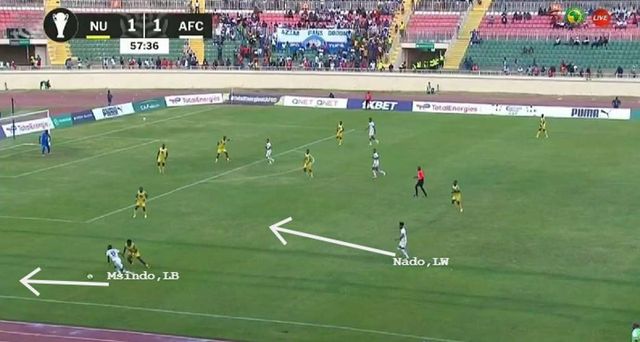
Feisal Salum frequently joined this triangle, creating consistent overloads against Nairobi’s right side.
This adjustment forced Dancun Omala into deeper defensive duties, limiting Nairobi’s counter-attacking potential and pinning them into their own half.
With both full-backs now advanced, Azam ensured security by dropping their double pivot deeper in build-up, maintaining balance and protecting against transitions.
Nairobi attempted to regain momentum through set-piece creativity, particularly via long throws from Dancun Omala, but Azam’s defensive organisation held firm.
The winning goal in the 78th minute came immediately after Nairobi’s double substitution, which saw Roy Okal and Enock Machaka withdrawn.
The timing was critical. Azam exploited the brief loss of cohesion with a routine free-kick sequence. Nado’s movement stretched Nairobi’s compact block, creating space for Himid Mao Mkami to receive and finish at the near post - aided by another goalkeeping error.
From there, Azam’s rest-defence and game management came to the fore. They slowed the tempo, circulated possession calmly, and used tactical fouls to disrupt Nairobi’s rhythm whenever transitions threatened.
This phase of control underscored Azam’s tactical maturity: possession was no longer about progression, but about protection.

Even while leading, Azam remained disciplined defensively.
Their mid-block stayed compact, with clear stepping triggers when Nairobi attempted central access. Recovery runs from wide players ensured full-back zones were protected, while the centre-backs maintained positional discipline against direct balls.
Nairobi United, by contrast, struggled to reassert control. Their attacks became increasingly direct, lacking the structural support needed to sustain pressure without exposing themselves defensively.
This match was decided not by sustained dominance but by control of key phases. Nairobi United showed intent, particularly in transition and pressing moments, but structural inconsistencies and individual errors proved costly.
Azam, meanwhile, demonstrated tactical clarity across all phases - from build-up and pressing to rest-defence and game management.
Statistically, the match reflected Azam’s control without dominance: 58% possession, five shots on target, and consistent chance creation through Salum, who finished with four key chances created.
Diaby’s 41 completed passes underscored his importance in progression, while Nairobi’s individual efforts - particularly John Otieno’s tackling and Owino’s dribbling - highlighted resistance rather than authority.
Nairobi United showed promise, especially in transition and pressing discipline, but Azam’s superior positional play, adaptability, and composure in critical moments proved decisive.
In a group-stage context where margins are slim, Azam’s ability to control chaos - rather than eliminate it - was the defining factor in securing all three points.