


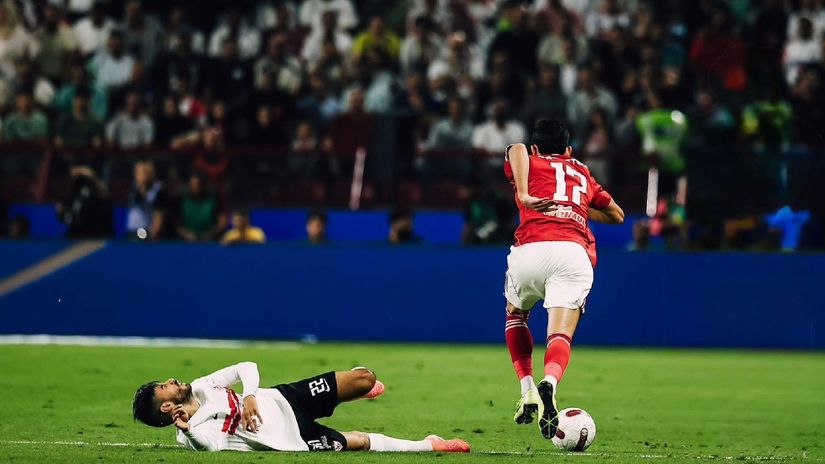
TACTICAL ANALYSIS: Al Ahly's tactical brilliance that overpowered Zamalek




Reading Time: 6min | Mon. 10.11.25. | 22:00
Al Ahly, coached by Jesús Christian Thorup, executed a well-organised plan marked by positional discipline and vertical compactness, while Abdel Raouf’s Zamalek sought to impose their rhythm through wide progression and controlled build-up play
The Mohammed Bin Zayed Stadium hosted another chapter in the fierce Cairo rivalry as Al Ahly and Zamalek SC met in the Egyptian Super Cup final in a test of tactical clarity, game control, and structural adaptability.
Follow our WhatsApp channel for more news
Al Ahly, coached by Jesús Christian Thorup, executed a well-organised plan marked by positional discipline and vertical compactness, while Abdel Raouf’s Zamalek sought to impose their rhythm through wide progression and controlled build-up play.
In the end, Al Ahly’s superior pressing coordination, transitional sharpness, and in-game management sealed a 2–0 victory and yet another trophy for the Red Devils.
Al Ahly started in a 1-4-3-3 formation, emphasising balance between progression and defensive security.
Mohamed El Shenawy commanded the goal, supported by a defensive line of Mohamed Hany and Ahmed Koka as fullbacks, with Ibrahim Yasser and Yassin Marei forming the central defensive partnership.
In midfield, Aliou Dieng and Marwan Attia operated as the double pivot - a combination of physical screening, ball progression and intelligent circulation - anchoring the side while offering security behind the advanced midfielder Ahmed “Zizo”, who had the license to roam into half spaces.
.jpg)
Ahead of them, Mahmoud Hassan Trezeguet on the left, Achraf Bencharki on the right, and Gradisar Najc as the striker provided width and penetration, shaping Al Ahly’s attacking trident.
Zamalek countered with a 1-3-4-3 structure, emphasising width and fluid rotations.
Mohamed Awad started in goal, behind a back three of Ismail Mohamed, Mahmoud “El Wensh” Hamdy, and Gaber Omar.
In midfield, Shehata Mohamed acted as the pivot, linking the backline with advanced playmaker Seif Gaafar, while Ahmed Fatouh and El Said Abdalla occupied the wing-back positions, pushing high to stretch Al Ahly’s structure.
Upfront, Maher Nasser and Chico Banza operated as wide forwards, flanking striker Nasser Amr, looking to exploit the spaces behind Al Ahly’s fullbacks during transitions.
From the outset, Zamalek adopted a patient build-up approach, seeking to lure Al Ahly’s high press and exploit the spaces behind it.
Their low build-up had both fullbacks positioned deep alongside the centre backs and the pivot acting as the main reference point to attract pressure.
The intention was simple: draw the opponent forward to create exploitable space behind them.
Al Ahly responded with an aggressive high block in a 4-2-3-1 shape, pressing in coordinated triggers and harmony in synchronisation, particularly when Zamalek played back to their goalkeeper or pivot.
This pressing intensity disrupted Zamalek’s rhythm, forcing several turnovers in their own half.
Off the ball, Zamalek defended in a 4-1-3-2 or 4-1-4-1 mid-block, maintaining compactness between lines and attempting to limit Zizo’s influence in the interior pockets.
However, Al Ahly’s verticality and quick side-to-side switches proved problematic.
The Reds overloaded the right flank with Hany, Bencharki, and Zizo, drawing Zamalek’s shape narrow before switching play diagonally to Trezeguet on the opposite side.
These positional rotations consistently created isolation opportunities for the wingers.
Zizo, operating as a roaming advanced midfielder, was crucial in linking transitions.
He often dropped deep to assist in progression, receiving between lines and switching tempo quickly. This flexibility allowed Al Ahly to control the rhythm while maintaining positional superiority.
Zamalek, however, looked dangerous on the counter.
Once they regained possession, they broke quickly through the flanks, especially with Banza and Nasser making diagonal runs behind the defense.
They relied heavily on third-man combinations and dropping movements from the striker to progress the ball forward.
Still, Al Ahly’s well-drilled midfield shield, led by Dieng, consistently intercepted vertical passes.
Al Ahly’s breakthrough came in the 43rd minute, a sequence reflecting their principles in a great tactical clarity fashion.
Zizo picked up the ball in the flank from Hany, and delivered a precise cross into the edge of the box.
Achraf Bencharki, showing his composure, controlled it expertly with his chest, rolled his marker, and fired a low finish into the bottom corner - 1–0 to Al Ahly.
The half ended with the Red Devils holding a deserved advantage, not only in scoreline but also in territorial control and pressing efficiency.
Zamalek began the second half with a triple substitution, signalling a more aggressive intent.
Ismail Mohamed, Nasser Amr, and Seif Gaafar were withdrawn for Hossam Abdelmaguid, Seifeddine Jaziri, and Juan Alvina Bezerra.
The changes shifted Zamalek’s approach - they moved into a 4-4-2 shape out of possession, pressing higher and pushing numbers forward in attack.
With Jaziri providing fresh movement upfront with well-timed vertical and diagonal runs in behind, Zamalek began targeting Al Ahly’s high defensive line through long balls and diagonal switches, especially toward the right flank where Juan Alvina operated.
This stretch created moments of discomfort for Al Ahly’s defensive unit, who were forced time and again to retreat quickly in recovery runs. Zamalek’s renewed aggression swung the momentum slightly, and for a period, they pinned Al Ahly deeper into their half.
However, Al Ahly responded with controlled transitions and intelligent spatial management.
The midfield duo of Dieng and Attia continued to dictate tempo, alternating between compact defensive positioning and progressive passing sequences. In transition, they quickly released the ball into wide areas, particularly towards the left, where substitute Taher Mohamed added dynamism.

The second goal arrived in the 71st minute, a textbook example of quick transitional execution.
Taher Mohamed received the ball on the left flank, drew multiple defenders toward him, and then delivered a sharp cutback metres from the six-yard box.
Marwan Attia, arriving late into the area, struck a low, bouncing effort that found its way into the net past the goalkeeper - 2–0 Al Ahly.
The sequence highlighted the team’s spacing awareness, with midfield and wide area runners timing their arrivals perfectly to exploit backpedalling defenders.
Zamalek attempted a comeback, maintaining their width and relying on set-pieces.
In the 78th minute, Maher delivered a teasing free-kick from the right flank that found Jaziri, who rose highest to head home - only for VAR to disallow the goal due to a handball in his header execution.
That moment effectively killed Zamalek’s momentum, while Al Ahly shifted to protect their advantage.
In the final stages, Thorup introduced tactical restraint, reshaping his team into a 5-4-1 defensive block.
With an additional centre-back reinforcing the line, Al Ahly absorbed Zamalek’s late pressure effectively. Their compactness between lines limited Zamalek to speculative efforts, and El Shenawy remained authoritative, commanding his area and producing key interventions when needed.
Ultimately, the 2–0 scoreline was a fair reflection of Al Ahly’s superiority.
They controlled the tactical rhythm, won the key midfield duels, and executed transitions with precision in a dynamic system that blended positional play, verticality and aggressive pressing.
Generally, it was a performance built on balance, structure, intensity and strategic intelligence - hallmarks of champions - and it reaffirmed Al Ahly’s place at the pinnacle of Egyptian and African football