


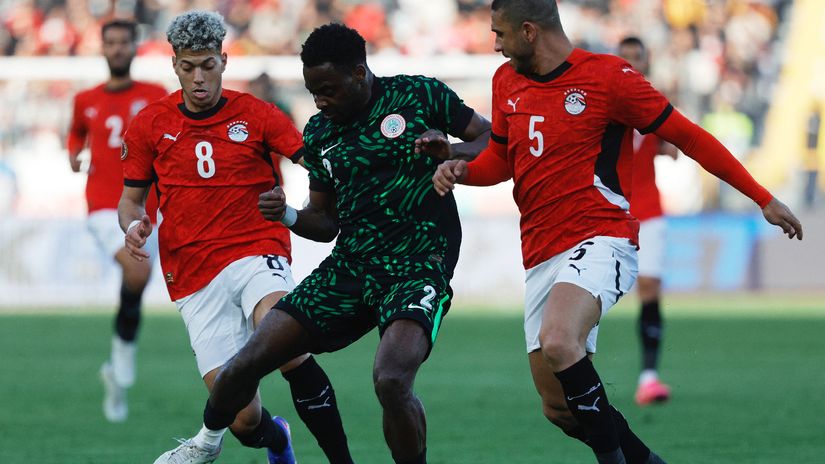
TACTICAL ANALYSIS AFCON 2025: How Osimhen-less Nigeria neutralised Salah to deny Egypt bronze


Reading Time: 4min | Sun. 18.01.26. | 20:06
This analysis explores the starting structures, defensive schemes, build-up mechanisms, pressing dynamics, and in-game adjustments that ultimately tilted the balance in Nigeria’s favour
Nigeria secured a goalless draw against Egypt before prevailing 4–2 on penalties in the AFCON 2025 third-place play-off.
Follow our WhatsApp channel for more news
While the scoreline in regulation time suggests a flat encounter, the underlying tactical story was shaped by Nigeria’s ability to dictate where the game was played and Egypt’s struggles to translate their counter attacking approach into sustained penetration.
This analysis explores the starting structures, defensive schemes, build-up mechanisms, pressing dynamics, and in-game adjustments that ultimately tilted the balance in Nigeria’s favour.
From the outset, the match carried a subdued narrative typical of third-place play-offs, but beneath that surface lay a clear tactical duel: Egypt’s attempt to control central zones through counter attacks versus Nigeria’s emphasis on width, physical reference points, and transition management.
Understanding how these contrasting ideas interacted explains why chances were limited and why Nigeria looked the more coherent side across phases.
Egypt began in a 4-1-2-3 structure, with Mostafa Shoubir in goal behind a back four of: Hany Mohamed, Rami Rabia, Fathi Hamdi, and Sobhi Khaled.
Lashin Mohanad anchored midfield as the single pivot, while Emam Ashour and Ahmed Zizo operated as advanced interiors between Nigeria’s midfield and defensive lines.
Mohamed Salah held width on the right, Trezeguet on the left, with Mohamed Mostafa leading the line as the central striker.
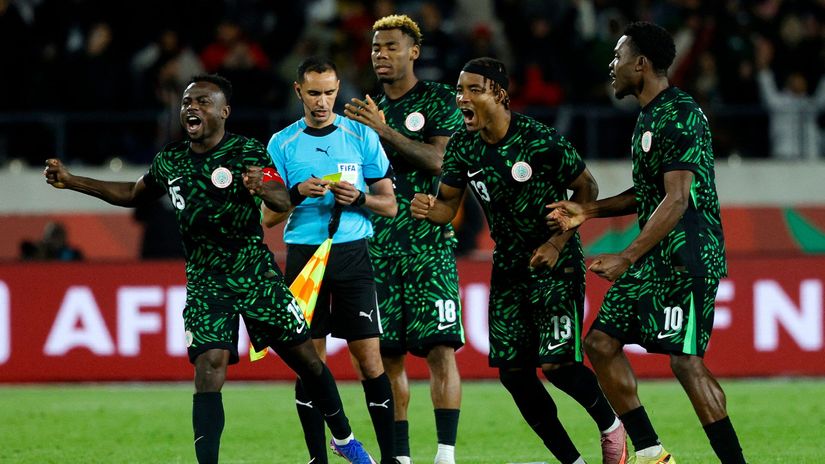
Nigeria, by contrast, lined up in a nominal 4-4-2 that frequently morphed into a 4-2-4/4-2-2-2 in possession.
Stanley Nwabali started in goal, protected by Bright Osayi-Samuel and Bruno Onyemeachi as full-backs, with Semi Ajayi and Igoh Ogbu centrally.
Raphael Onyedika anchored midfield, Dele-Bashiru played ahead of him, while Samuel Chukwueze and Moses Simon occupied the wide midfield roles, often pushing high.
Akor Adams partnered Paul Onuachu up front, creating a twin-striker reference point.
Out of possession, Egypt defended in a 4-1-4-1 mid-block that morphed to a 5-4-1 low-block.
Their priority was central compactness, with Ashour and Zizo dropping alongside the wide midfielders to protect the half-spaces, leaving Mostafa isolated ahead and Lashin protecting the space in front of the back four.
This approach aimed to deny Nigeria central progression and force them wide, trusting the back line to deal with crosses.
Nigeria, meanwhile, defended in a compact 4-4-2.
Their wingers tracked back diligently, often dropping inside to close passing lanes into Egypt’s wide forwards.
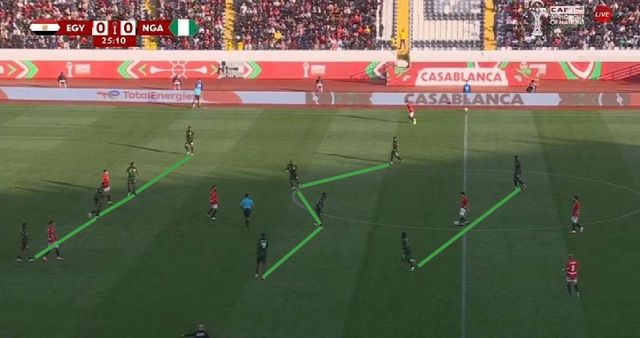
This man-aware but zonally compact approach limited Egypt’s ability to transition quickly through Salah and Trezeguet, forcing them into slower, more predictable build-up and attacking phases.
The key issue for Egypt was that their defensive block rarely turned into a platform for well structured attacking transitions, largely because Nigeria’s rest-defence and counterpressure were well executed.
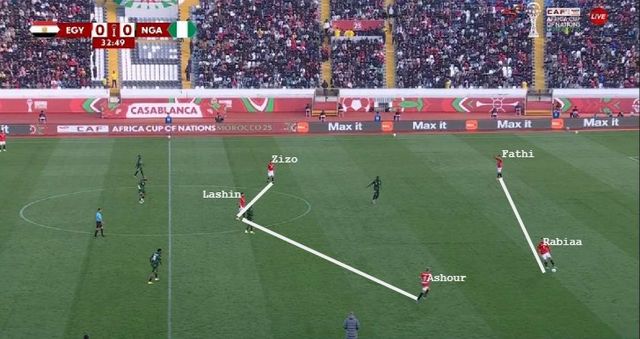
In possession, Egypt attempted to build in a 2-3-5 structure.
The two centre-backs stayed deep, Lashin anchored centrally alongside Zizo and Ashour, while both full-backs pushed high to support the wingers.
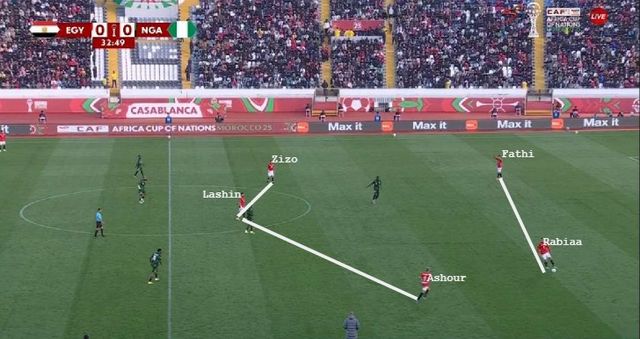
As they progressed high, Ashour and Zizo positioned themselves between the lines, looking to receive on the half-turn and connect with Salah and Trezeguet.
Nigeria responded by holding a relatively high defensive line, which forced Nwabali into an active sweeping role.
This created a narrow but aggressive rest-defence, designed to compress space between the lines and discourage Egypt’s through passes.
Nigeria’s own build-up was more direct and situational.
Goal kicks and restarts were frequently played long and centrally towards Onuachu.
This was not aimless: by targeting him as a fixed reference point,
Nigeria consistently dragged an Egyptian centre-back out of the defensive line.
That movement opened space behind, which Moses Simon or Akor Adams were tasked to attack from the flanks and half-spaces.
The cause-effect relationship was clear - long ball to Onuachu, centre-back steps out, second runner exploits the vacated channel.
Egypt’s main structural vulnerability lay in the space behind their advanced full-backs and the reliance on individual duels in wide areas.
Nigeria repeatedly targeted this by overloading the left side, combining Onyemeachi’s overlapping runs with Simon’s ability to drift inside.
Akor Adams’ mobility further amplified this, as he frequently moved into the left half-space to create numerical superiority.
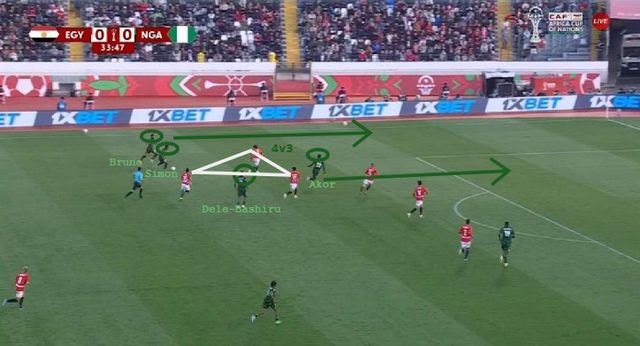
The disallowed first-half goal illustrated this pattern perfectly.
The move originated from Nigeria’s left, with Simon delivering from a wide area after Onyemeachi’s forward run.
Chukwueze’s initial header forced a save, and the second phase saw Akor finish at the near post.
Although the goal was ruled out for a foul by Onuachu, it served as a case study of Nigeria repeatedly accessing dangerous zones through wide-to-central progression.
Nigeria’s dominance was most evident in the wide channels and left half-space.
By committing numbers to the flank, they forced Egypt’s midfield to slide across, which in turn limited Egypt’s ability to protect Zone 14 consistently.
Onyemaechi drove down the left to deliver crosses for Akor and Onuachu in the penalty box or attack the blind side of Egypt’s left-back for Chukwueze, which in turn drew Moses Simon into the left half-space, while Onyedika, the two centre-backs and the right-back held the rest defence against Egypt’s 5-4-1 low block
Egypt’s wide protection often came at the expense of central access, but Nigeria’s final execution lacked the precision to fully capitalise in open play.
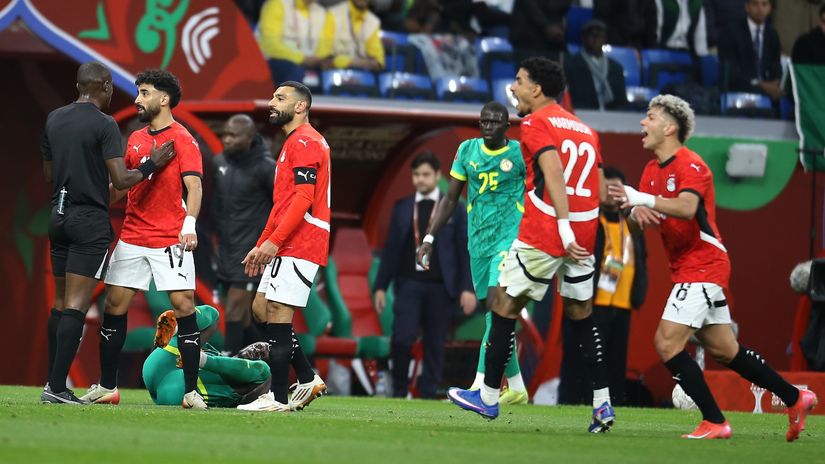
Conversely, Egypt struggled to dominate any specific attacking zone after probing continuously through Salah’s and the subbed-in-Marmoush through counter attacks.
Their left-side combinations involving Ashour and Sobhi showed promise, but Nigeria’s winger tracking and compact back line denied them sustained access inside the box.
Egypt attempted to press high early on, looking to force turnovers for quick attacks.