


TACTICAL ANALYSIS: AFC Leopards' smart gameplan that forced Gor Mahia into total submission
.jpg)
.jpg)

Reading Time: 5min | Mon. 08.12.25. | 20:04
At the final whistle, AFC Leopards had produced a complete tactical shutdown of Gor Mahia - controlling the tempo without needing overwhelming possession
After being part of the 1998 AFC Leopards' title-winning squad, Fred Ambani did not know that he would one day etch his name into Ingwe folklore as the coach who silenced arch rivals Gor Mahia 27 years later.
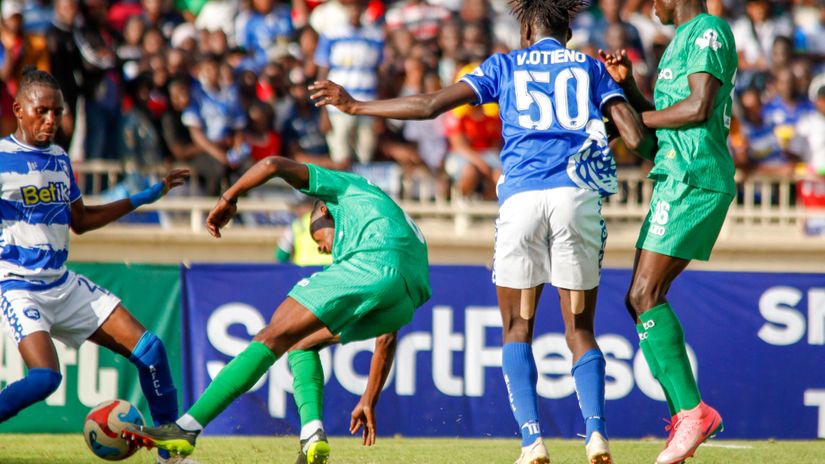
Not many derbies come as big as AFC Leopards versus Gor Mahia on the African continent, and both sets of fans were treated to a firecracker of a match that ended with Ingwe edging K'Ogalo 1-0.
AFC Leopards delivered a tactical masterclass against Gor Mahia, shutting down their rhythm, suffocating their key creators, and dictating almost every phase of the match through intelligent pressing, compactness, and well-orchestrated positional movements.
From the opening whistle, both sides revealed contrasting structures: Gor Mahia aimed to build with fluidity and width, morphing into a 3-5-2 in possession, while AFC Leopards assembled a disciplined, compact, and aggressive 4-2-3-1/4-4-2 shape that disrupted Gor’s buildup at source.
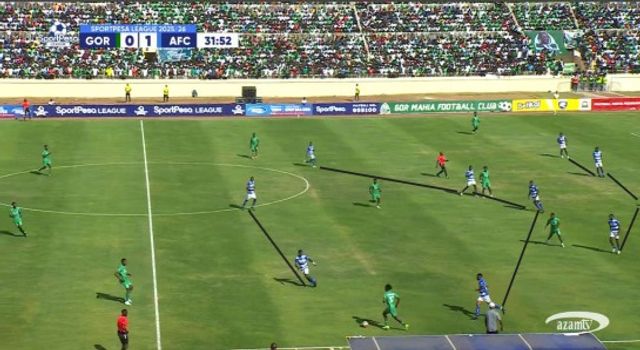
AFC Leopards deployed an aggressive, compact 4-4-2 mid-block out of possession, closing central lanes, compressing space, and forcing Gor Mahia into wide, predictable long passes.
Gor started with Byrne Omondi in goal and a backline of Bryton Onyona, Paul Ochuoga, Mike Kibwage, and Sylvester Owino, with Enock Morrison and Fidel Origa forming the double pivot responsible for both progression and coverage.
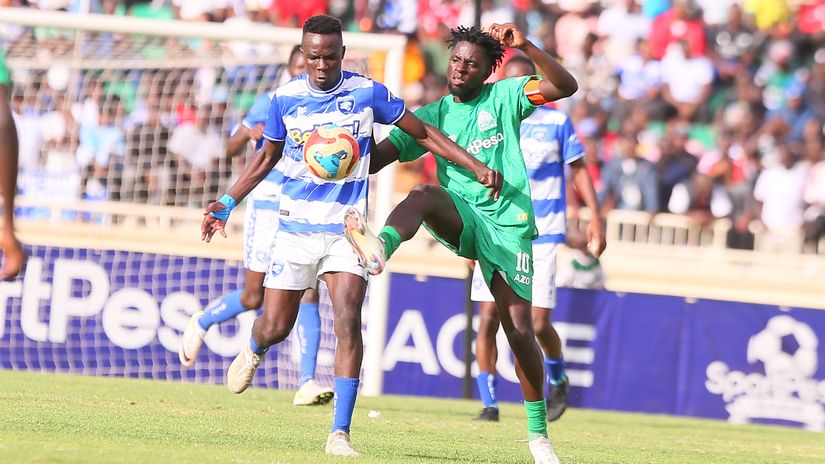
Their advanced midfielder, Austin Odhiambo, operated between the lines, drifting to link play with the wide players Shariff Musa and Ebenezer Adukwaw, while striker Felix Oluoch rotated across channels and half-spaces.
The intention was clear - push fullbacks high, stretch AFC Leopards horizontally, and allow Morrison to drop between the centre-backs to create a back three for stable circulation against the press.
However, Fred Ambani’s AFC Leopards arrived with an intelligent, proactive plan that neutralised these intentions. Humphrey Katasi started in goal, shielded by centre-backs Kayci Odhiambo and Randi Bakari.
On the right, Brian Ojok maintained a conservative approach, while on the left, Samuel Semo acted almost like a wing-back, supported by a double pivot of Boniface Munyendo and Musa Oundo, who controlled central stability.
Ahead of them, Tyson Otieno thrived in the pocket between Gor’s midfield and defence, constantly receiving in tight spaces and dictating transitions.
Victor Omune provided the reference point up top with his hold-up play and physical duels, while James Kinyanjui stayed wide on the right to deliver early crosses, and Julius Masaba inverted into the left half-space to combine centrally.
From early on, Leopards showed their intent by overloading the left flank to lure Gor Mahia into defensive shifts. Once the ball was circulated to the overloaded side, AFC produced subtle passing triangles and third-man combinations, particularly involving Semo, Masaba, and Tyson Otieno.
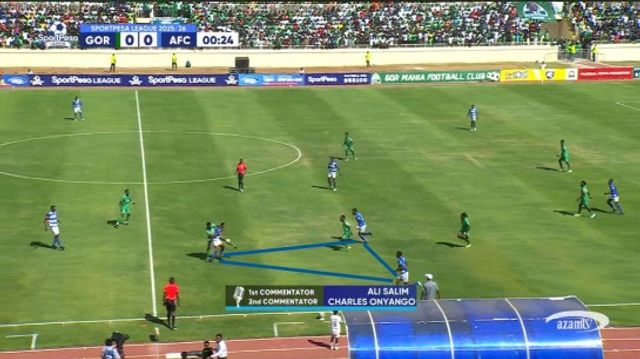
Ingwe repeatedly overloaded the left flank, with Semo’s overlapping surges and Masaba’s forward bursts combining with Tyson’s perfectly timed lay-offs to pull Gor Mahia’s defenders out of shape and attack the space at pace.
This trio created constant passing triangles, third-man runs, and dynamic rotations that disorganised Gor Mahia’s defensive line and opened progressive lanes into the final third.
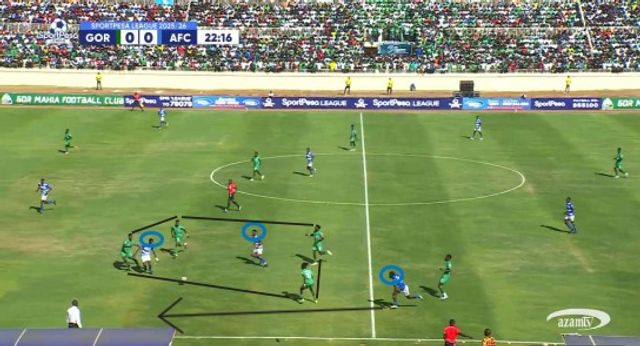
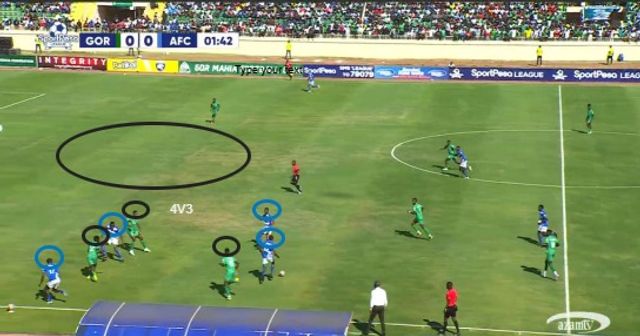 AFC Leopards manufacturing a 4v3 overload on the left flank, dragging Gor Mahia’s central defender out of position and opening large pockets of space in the backline for penetrative runs and final-third progression.
These fluid movements repeatedly disoriented Gor Mahia’s defensive structure, especially exploiting the advanced positioning of right-back Ochuoga, who often left large pockets behind him.
Omune’s hold-up play further enhanced these moves, as he drew defenders towards him, enabling Tyson to receive facing forward and connect play at speed.
This pattern - progression through the left, switch or combination through Tyson, then delivery toward Omune or the advancing fullback - became a recurring and highly effective sequence.
Defensively, AFC Leopards executed one of their most synchronised presses of the season.
Their 4-4-2 out-of-possession block remained compact, denying Gor any central progression.
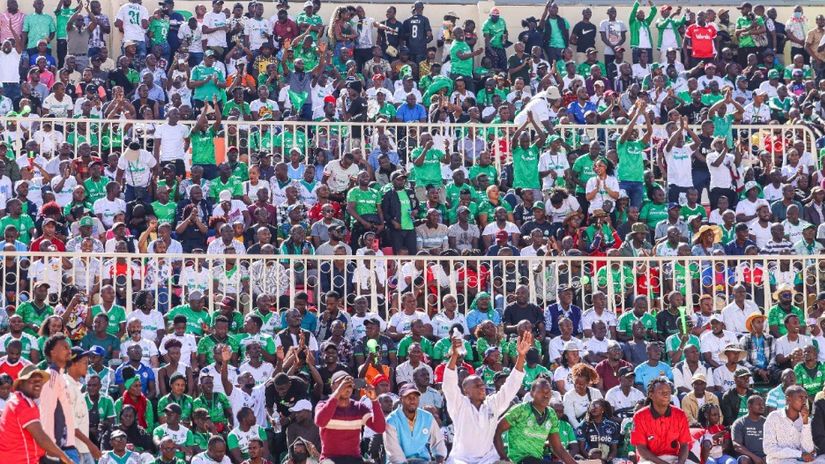
They triggered aggressive presses when the ball was played into wide areas or into a midfielder receiving with his back to goal. This forced Gor Mahia to abandon their initial possession-based intentions and resort to long balls into the channels, which AFC dealt with comfortably.
The wingers worked tirelessly, making recovery runs to ensure their fullbacks were never exposed, maintaining a tight defensive block with minimal distances between lines.
Gor Mahia’s playmakers, particularly Morrison and Austin Odhiambo, were persistently denied time on the ball - the moment either received, AFC Leopards midfielders(Musa Oundo and Boniface Munyendo) stepped in aggressively, forcing rushed decisions and backwards play.
The opening goal in the 25th minute perfectly reflected AFC Leopards' rehearsed attacking patterns.
A shot from Tyson Otieno in the right half-space forced a save from Byrne Omondi, but the quick rebound fell to Masaba, who reacted sharply to slot the ball home.
The move leading up to the goal involved quick combinations that dragged Gor’s shape toward the flank, creating an inside channel for Tyson to exploit, and ultimately generating the shooting opportunity.
.jpg)
Gor Mahia made adjustments in the second half, pushing Shariff Musa more inside from the left, allowing Bryton Onyona to venture forward in attack and encouraging long-range attempts by Austin Odhiambo and Morrison.
The introduction of Alpha Onyango provided more midfield control, and Onyona’s increasingly advanced role forced AFC’s wingers, especially Kinyanjui, into deeper recovery runs.
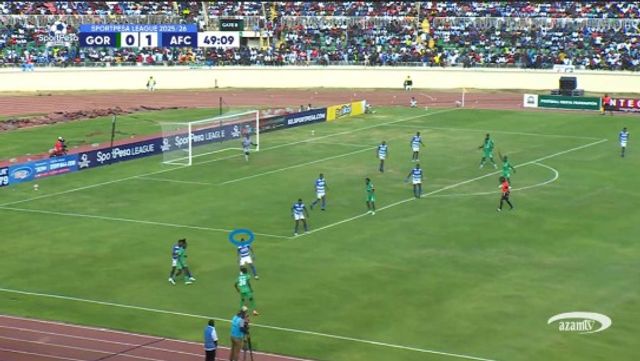
AFC Leopards’ right winger James Kinyanjui consistently tracked back to cover Gor Mahia’s advancing left-back Bryton Onyona in the second half, ensuring defensive balance and preventing overloads on that flank.
However, Ingwe adapted seamlessly, transitioning into a more conservative structure when needed, focusing on transitions and long clearances toward Omune, who continued winning crucial duels to relieve pressure.
The compactness between lines remained intact, ensuring that even when Gor advanced into the final third, their opportunities were reduced to half-chances.
Substitutions from both sides added energy but did not alter the tactical balance.
Gor Mahia’s shift into a 3-2-5 late in the game increased their attacking presence, yet AFC Leopards' disciplined low block, proactive goalkeeping from Katasi, and coordinated defensive movements kept them safe.
Each attempted cross, long throw, or switch from Gor was met with immediate pressure, aerial dominance, or intelligent containment.
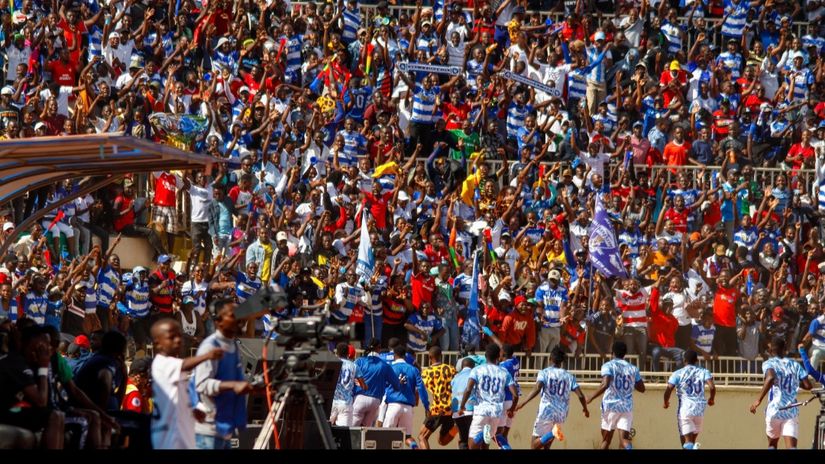
By the final whistle, AFC Leopards had produced a complete tactical shutdown of Gor Mahia - controlling the tempo without needing overwhelming possession, dictating structural battles, exploiting positional weaknesses, and pressing with cohesion and intent.
Their blend of compact defending, fluid wide rotations, and well-timed attacking patterns made this one of their most organised and effective performances, a match defined by structure, discipline, and tactical superiority.