


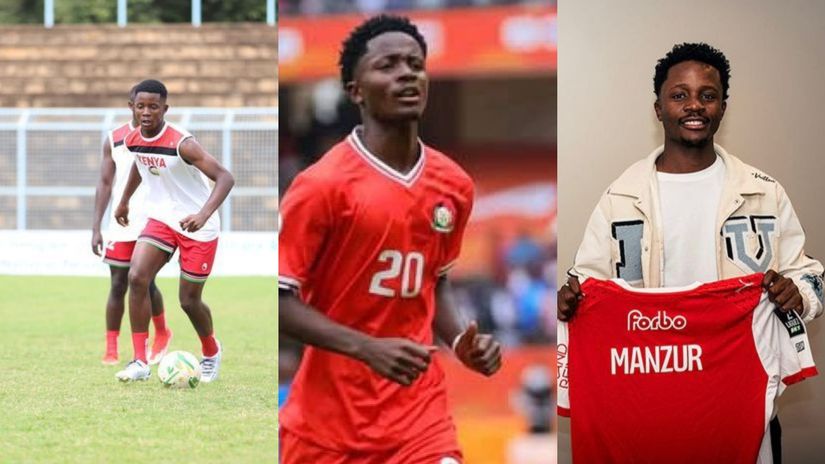
PLAYER ANALYSIS: What Harambee Stars midfielder Manzur Okwaro brings to French side Reims

.jpg)


Reading Time: 5min | Thu. 29.01.26. | 20:16
At just 19, Manzur arrives not as a blank developmental project, but as a tactically formed player whose evolution through Kenyan football and growing importance within the national team has accelerated his understanding of space, tempo, and structure.
Forget the usual "high-upside prospect" narrative: Manzur Okwaro steps into France's Ligue 2 already carrying the weight of responsibility that belies his years.
Follow our WhatsApp channel for more news
His rapid Kenyan rise, capped by Benni McCarthy's bold experiment turning him into a midfield general at the 2024 African Nations Championship (CHAN), has forged a player who dictates tempo, shields backlines, and progresses play with poise rarely seen in teenagers.
Far from a developmental gamble, this loan (with an obligation to buy) is Reims betting on controlled evolution: sharpening an already proven hybrid pivot whose spatial intelligence, anticipation, and left-footed reliability could make him a central orchestrator in one of Europe's toughest second divisions.
Okwaro’s move to Stade de Reims is less about raw potential and more about refining a profile that already carries responsibility well beyond his age.
At just 19, he arrives not as a blank developmental project, but as a tactically formed player whose evolution through Kenyan football and growing importance within the national team has accelerated his understanding of space, tempo, and structure.
His positional journey, from left-sided centre-back to full-back and then into defensive midfield, has been crucial in shaping the all-round midfielder Reims are now inheriting.
.jpg)
Under McCarthy with the Harambee Stars, Okwaro has become an essential reference point in build-up and ball progression.
Rather than simply shielding the back line, he functions as a hybrid pivot who influences every phase of play. He exceeds average benchmarks across duels, dribbling, and progressive actions, underlining his comfort both in defensive engagement and on-ball responsibility.
What stands out most is his contribution to possession: he consistently scans his surroundings, opens his body intelligently, and offers clean, reliable passing angles to centre-backs during the first phase.
![Government provides latest update on 85% complete Talanta Stadium [VIDEO]](https://cdn3.mozzartsport.co.ke/upload/825x464/News/Image/2026_01/1769702465129_Untitled_design_-_2026-01-29T185951.009.jpg)
This allows his teams to sustain build-up under pressure rather than defaulting to long clearances.
His composure in tight spaces is particularly notable for a player of his age. Okwaro manipulates angles with minimal touches, shields the ball effectively using his body, and rarely panics when closed down.
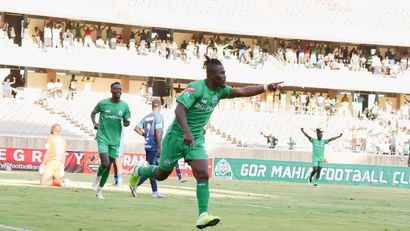
This trait was evident during the CHAN tournament, where he covered vast midfield zones through intelligent positioning rather than excessive physical output.
He links play smoothly, maintains control without burning energy, and ensures continuity in possession - hallmarks of a true pivot rather than a converted defender.
In transition-heavy moments or when his side dominates territory, Okwaro’s influence deepens.
He directs attacks from deeper zones, exploiting half-spaces with disguised line-breaking passes and switching play with measured diagonals. While he is not a final-third specialist, his value lies in tempo control and deep progression.
He connects phases, ensures fluidity, and gives attacking players a stable platform from which to operate.
This ability to orchestrate from behind the ball is why he increasingly dominates the central zone rather than merely occupying it.
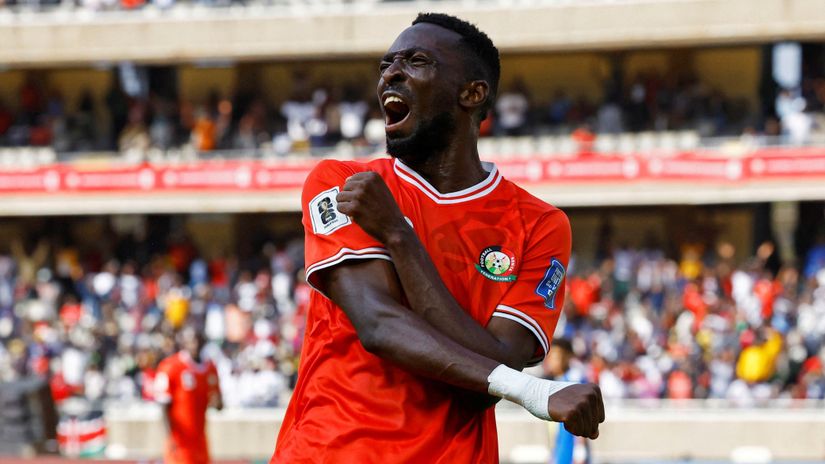
Out of possession, his intelligence is equally clear. Okwaro positions himself to block passing lanes, shifts laterally to support pressing traps, and makes sound decisions when stepping out to engage.
His defensive awareness allows him to function in both zonal and man-oriented systems, whether in a double pivot or as part of a midfield three.
This versatility is attractive for Reims, but it also presents a developmental risk if not handled with clarity.
For Reims, the task is refinement, not reinvention. Ligue 2’s tactical environment is unforgiving in midfield, where spacing errors and mistimed aggression are quickly exposed.
Okwaro’s instinct to step forward and assert himself must now be balanced with restraint - knowing when to hold position, when to slide across, and when to engage vertically.
This timing will determine whether he becomes a controlling pivot or remains a reactive ball-winner stepping into midfield from defensive habits.
In possession, his adaptation will revolve around the speed of thought rather than technique. His passing range is already strong, particularly in short-to-mid distances, but French football will demand faster recognition of pressure cues and quicker release to maintain rhythm.
Reims’ preference for controlled build-up - often inviting pressure before exploiting central or wide gaps - suits his profile, provided his decision-making continues to sharpen.
The physical tools and technical base are in place; cognitive tempo is the next layer.
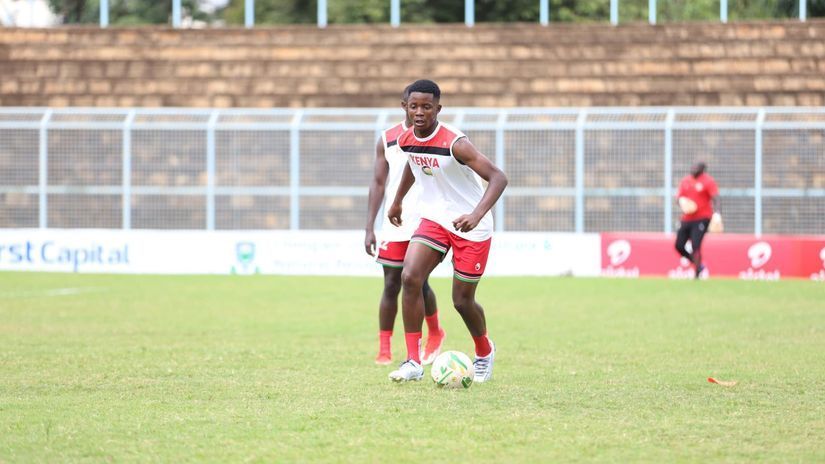
A full transition into midfield appears not only realistic but optimal. His CHAN performances showed he can offer control and stability as a central reference point, constantly making himself available and dictating flow.
However, the progression should be phased. Short-term exposure through reserve matches and structured senior training will allow him to absorb positional principles without excessive game-state stress.
Mid-term integration as a deep-lying midfielder in selective Ligue 2 appearances would allow his defensive reading to anchor transitions and protect the back line. Long-term, he has the profile to evolve into a mobile central midfielder who supports attacks while retaining defensive balance.

Systemically, Reims can accommodate him in several ways. A double pivot would ease his adaptation, pairing him with an experienced distributor while maximising his ball recovery, shielding, and short progression.
A single-pivot role would place heavier responsibility on his positioning and distribution, but could ultimately make him a system-defining anchor.
His left foot adds balance to circulation, enabling smoother switches and early progression that stretch opposition blocks.
Okwaro’s greatest immediate value may come in transition moments.
His ability to secure space behind advancing full-backs provides structural security, while his anticipation helps slow counters during counter-pressing phases.
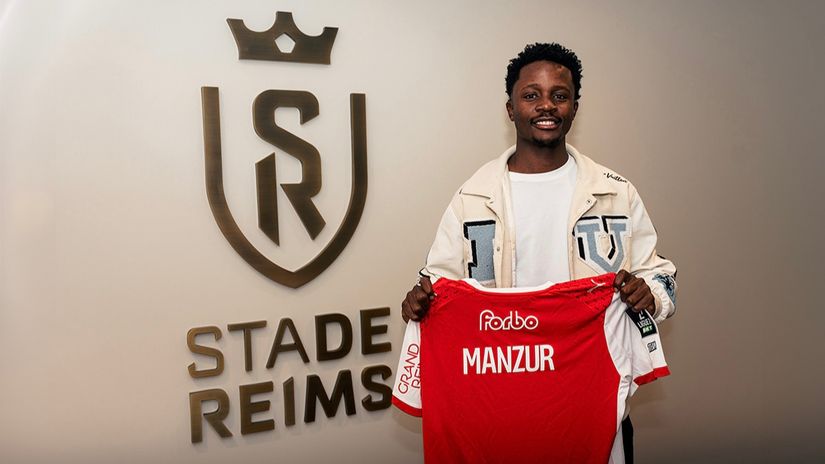
His knack for quick recoveries allows Reims to recycle possession efficiently in a league where turnovers often decide matches.
To maximise his trajectory, Reims must offer patience and clarity. A defined positional pathway will prevent role dilution, while targeted coaching on spacing, pressing triggers, and circulation will align his instincts with Ligue 2 demands.
The presence of Joseph Okumu also offers an important cultural and professional reference - someone who understands the adaptation curve for Kenyan players in Europe.
Ultimately, Manzur Okwaro arrives at Stade de Reims with the tools to become more than a squad option. He is already a midfielder who controls rhythm, dominates central spaces, and connects phases with intelligence.
With structured development and tactical clarity, a full transition into a deep midfield role could unlock his highest ceiling - transforming him into a system-shaping presence built on composure, progression, and defensive authority.