


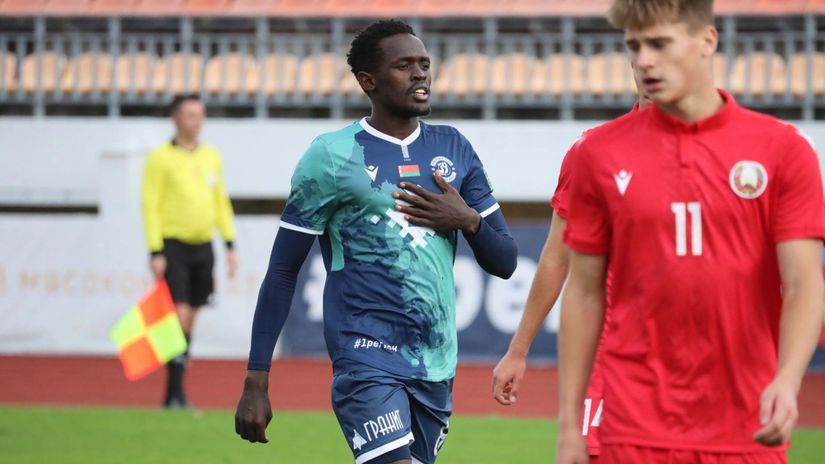
PART ONE: Former street boy Josphat Lopaga on how Rio Ferdinand's gift fuelled his professional career





Reading Time: 7min | Sat. 01.11.25. | 20:37
In his childhood, football was not about dreams of Europe or television idols. “We didn’t even have a TV,” he says. “I didn’t have any heroes. I just knew that playing made me happy.”
It is a balmy afternoon in Kakamega, and the town is slow to wake. The smell of rain still hangs in the air from the morning drizzle. A few hours earlier, I had watched Josphat Lopaga train with his teammates on the muddy pitch at Lions Club.
Follow our WhatsApp channel for more news
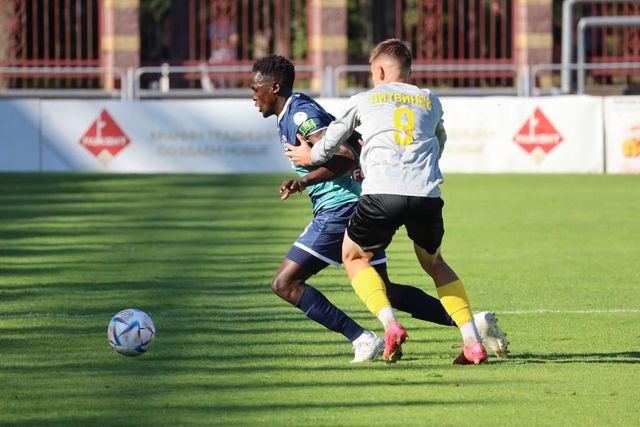
It was heavy ground, the kind that sucks at your boots and stains your socks long after the whistle goes. For a man who has played under the heat of Muscat, Oman and the snow of Minsk, Belarus, this was a different world.
![A look at Talanta Stadium's special technology lighting up outer walls like Allianz Arena [VIDEO]](https://cdn3.mozzartsport.co.ke/upload/825x464/News/Image/2025_10/1761409453767_Untitled_design_-_2025-10-25T192239.117.jpg)
Later, we meet at Holden Mall, inside a small coffee shop that hums quietly in the background. Cups clink. The ceiling fans spin lazily. Lopaga arrives dressed in boots, a white tee, pants, and a silver chain that catches the soft light. He sits across the table, relaxed but alert, like a man who carries his story carefully.
“Football makes me happy,” he says. “It’s always been my escape.”
He smiles as he says it, almost shyly. The words come easily, but the weight behind them is harder to ignore. For Lopaga, football has never been about luxury or recognition. It was survival, a small light in the middle of a rough beginning.
Baragoi Beginnings
He was born in Baragoi, Samburu County, a place more famous for its conflict than its footballers. “It’s hot and dry there,” he says. “There isn’t much to play with. We made balls from plastic bags. When you really want something, you make do with what you have.”
He says it plainly, not looking for pity. “When you grow up with nothing, you learn to work hard for everything,” he adds. “It also makes you appreciate what you have.”
In his childhood, football was not about dreams of Europe or television idols. “We didn’t even have a TV,” he says. “I didn’t have any heroes. I just knew that playing made me happy.”
Later, in Nyahururu, life changed. “I was living on the streets,” he recalls. “There was a white man who used to let us play ball. That’s where I built my style—grit, competition, the hunger to win.”
He pauses for a moment. “It was an escape, but also a lesson. You learn how badly you want something when it’s all you have.” Baragoi, with all its hardship, made him unbreakable.
“When you live there, very few things can faze you,” he says. “You grow up fast. It can be life or death sometimes. That puts things into perspective.”
Learning the Streets
He left home because it was hard to live there, even for a boy who had barely hit his teens. The sun in Baragoi burned everything bare. The ground was cracked, the air dry, the silence broken only by the low hum of wind over dust.
He took off and learned to work the streets, his mind sharp enough to know what to do and what not to do to survive.
.jpg)
He never touched drugs, even when they could have quieted the noise around him. Instead, he found rhythm in the chaos. He found movement. Football became the one thing that made sense. Each kick was an answer, each pass a small act of defiance.
He did what he had to do until he reached Nairobi. There, on one of those restless afternoons when the streets buzzed with matatus and shouts, a Posta Rangers coach noticed him. The man saw something more than a street kid chasing a ball. He saw potential. He told him to go back to school.
It was not easy. Discipline felt foreign after years of survival. But he had two choices: stay on the streets or start again. He knew what he did not want—nights that ended in uncertainty and mornings that began with hunger.
He settled in Umoja, a place that pulsed with life. Dusty pitches and narrow alleys became his training ground. He learned how to beat his man, how to thread impossible passes, how to find the corners of the goal that no keeper could reach.
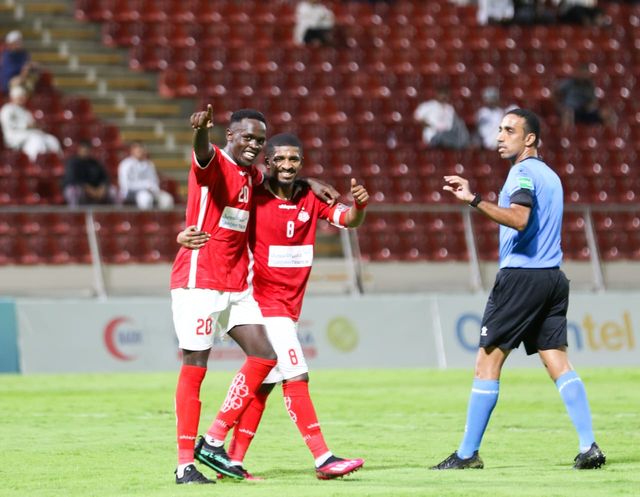
Those moments, captured in shaky clips and shared between coaches, found their way across borders. A club in Oman saw something in him, grit, speed, heart, and reached out.
His first flight felt unreal. He spent most of it staring out the window, watching clouds drift past and whispering to himself that he would never go back to the life he had left behind. It had to work. It must work.
A Glimpse of the World
In 2018, Lopaga’s name began to spread. “I remember playing against Rio Ferdinand in a Guinness promotional event,” he says with a grin. “He was impressed and gave me his boots.” He laughs at the memory, shaking his head. “That moment told me I could play at the highest level.”
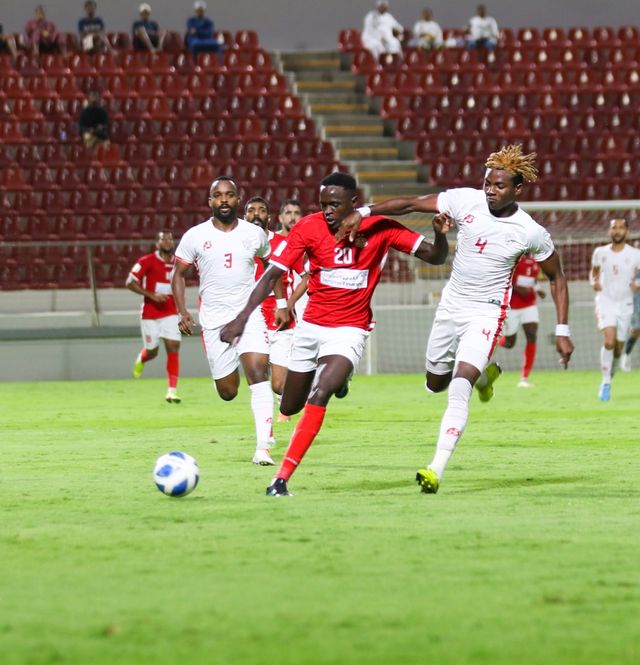
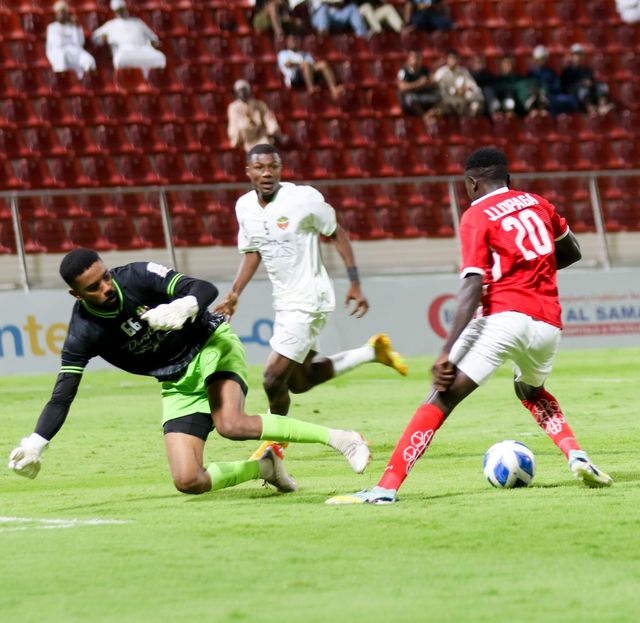
From there, doors began to open. His first major move came when he signed for a club in Oman. The country’s heat was punishing, the culture different, and the standards high.
“It was my first time outside Kenya,” he says. “Culturally, it was new, but it was good. I learned discipline and professionalism. I learned how much hard work goes into being a footballer.”
Oman gave him confidence. Belarus gave him character.
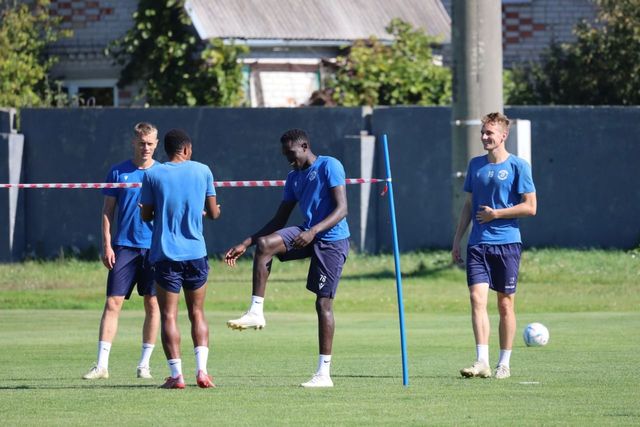
“When I landed in Minsk, I thought the world had stopped moving,” he says. “It was so cold. I’d never felt cold like that. Minus four, sometimes worse.”
He smiles at the memory. “Russian is hard too. Even the letters look angry,” he jokes. “But I loved it. The football was structured, very technical. It grew me as a player and as a person.”
He talks about Dynamo Brest with quiet pride. “Everything was disciplined. You eat at the right time, sleep at the right time, and train with purpose. You realise football is a lifestyle.”
Still, the loneliness lingered. “After training, I’d go back to my apartment and just sit. No family, no noise. That’s when you start to understand what really drives you.”
The Return
When his time abroad drew to a close, Lopaga came home. Not to Nairobi, but to Kakamega. “When Homeboyz called, it felt right,” he says. “They have a vision. They’re a top-five club. They’ve come close before, and I wanted to help them get there.”
For some, it looked like a step down. To Lopaga, it was something different. “When you know what you want, you don’t care how it looks,” he says. “You just go for it.”
At Homeboyz, he found a team built on hunger. “The bunch is young,” he says. “We have a mix of youth and experience. Everyone has something to prove. Nobody treats me like a star.”
Training in Kakamega is not like Europe. “The facilities are different,” he admits. “But we have the passion. With the right leadership and investment, Kenya can be a football nation. We have the talent.”
He glances out the window. The streets below are loud with motorcycles and music. “It’s coming,” he says quietly. “Kenyan football will rise.”
The Core of It
What drives Lopaga is not fame or the chase for a big move. It is love. “Be patient,” he says. “Your time is coming.” He has played in silence and in front of crowds. “It’s the same feeling,” he says. “You just want to give everything.”
Some people mistake his confidence for arrogance. “People think I’m rude or hot-tempered,” he says. “I just speak my mind. I don’t like filters. But I’m not chasing attention. I just love the game.”
Now entering his mid-twenties, Lopaga’s focus has shifted from himself to others. “I started Lopaga Sports Club,” he says.
“It’s a platform for kids to showcase talent, but also to promote peace. Where I come from, peace is something you have to build every day.” He speaks slowly now, measuring every word. “Football gave me a life,” he says. “I want it to give others the same.”
Legacy
When I ask how he wants to be remembered, he does not hesitate. “As a humble guy who just wanted to achieve his dreams,” he says.
Outside, the rain begins to fall again, tapping lightly against the glass. Inside, the air smells of roasted beans and wet earth. Lopaga finishes his coffee and adjusts his chain. “I’ve seen the world,” he says with a small smile. “But this… this is home.”