


Confusse the enemy — pink locker rooms, unbrushed teeth, overgrown grass








Reading Time: 5min | Tue. 11.11.25. | 14:20
“The end justifies the means,” said Machiavelli in his book in the 16th century. Half a millennium later, that principle has found its way into football too
Sunderland snatched a valuable point against Premier League leaders Arsenal on Saturday, courtesy of a thrilling equaliser deep into stoppage time.
While Brian Brobbey’s stunning 94th-minute overhead kick rightfully grabbed the headlines and Mikel Arteta lamented the “chaos” caused by Sunderland’s direct style, it wasn’t the only thing that drew attention at the Stadium of Light.
The hosts had a clever trick up their sleeve — one that was more tactical than technical. In an effort to blunt Arsenal’s set-piece threat, particularly from long throw-ins, Sunderland staff discreetly shifted the advertising boards, cutting down the space the Gunners needed to generate momentum for their launches.
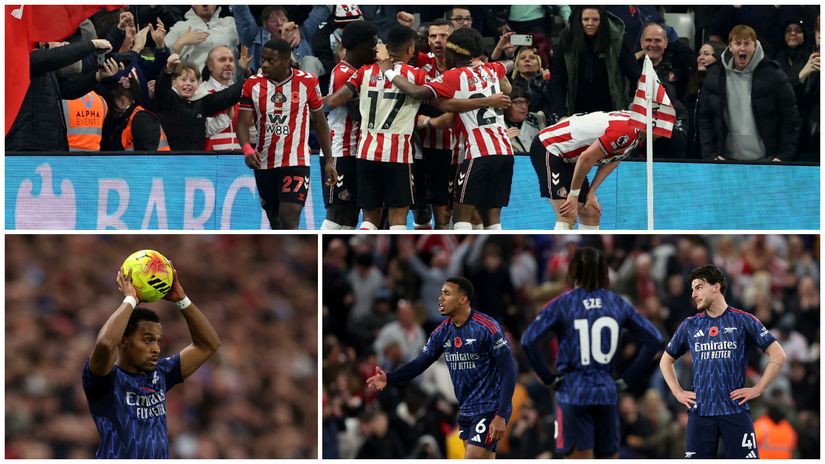
“It might have been the wind,” manager Regis Le Bris quipped after the match. The move didn’t completely stop Declan Rice from attempting his trademark throws, but given that Arsenal never capitalised and the contest ended level, Sunderland’s ploy seemed to pay off.
"Might have been the wind!" 😂
— Hayters TV (@HaytersTV) November 8, 2025
Regis Le Bris asked about Sunderland’s advertising hoardings being closer to the pitch than normal 👀 pic.twitter.com/HjW3yYJlQV
It’s not the first time they’ve tried it either — the same trick appeared during last season’s Championship play-offs against Coventry, echoing complaints once made by Rory Delap, Stoke’s long-throw icon, about teams narrowing his runway.
Sunderland have moved the advertising hoardings closer to the pitch to stop Coventry’s long throws 🤣🤣 pic.twitter.com/HBtYbZlzSk
— Second Tier podcast (@secondtierpod) May 13, 2025
Football’s history is full of such inventive schemes — moments of mischief and ingenuity that would have made Machiavelli himself proud. We will bring to you some of them.
Norwich’s pink mind games
Winning a football match isn’t only about tactics and skill — sometimes psychology plays its part too. That was the thinking behind Norwich City’s curious decision in the 2018–19 season.
In an effort to gain even the slightest advantage over visiting teams, the Canaries painted their away dressing room “deep pink.” The logic? The color supposedly reduces testosterone levels and induces calmness — not exactly ideal conditions for fired-up opposition players.
📆 5 Days Ago:
— SPORF (@Sporf) August 25, 2018
🎨 @NorwichCityFC paint their away dressing room "deep pink" to lower their opponents testosterone levels:
📆 Today:
❌ Norwich City 0-3 Leeds United.
🤷♂️ pic.twitter.com/75j6JVZG7n
"Pink has an effect, not because it is pink, but because it's linked to childhood experiences," explained Dr Alexander Latinjak, a sport psychology lecturer at the University of Suffolk.
"If it is true that pink lowers testosterone levels, then the coach should know exactly how to use that advantage tactically."
Norwich borrowed the concept from the University of Iowa’s American football program, where similar color psychology experiments had been used for years. Though the team lost two of their first three home matches, the season ended in promotion to the Premier League, so maybe the mind games paid off.
BREAKING!! After a Leeds United hammering, Norwich City have repainted the pink dressing room Yellow, White & Blue as the thought of Leeds terrifies opponents! #LUFC #NCFC pic.twitter.com/MJoq14Jkvh
— Leeds Everywhere 🌍 (@LeedsEverywhere) August 25, 2018
When the pink walls were swapped for white ahead of the 2019–20 campaign, Norwich promptly got relegated. Coincidence? Probably — but fans still like to wonder.
Mourinho’s long grass strategy
If there’s one thing Jose Mourinho has never shied away from, it’s mind games — and lawn games, apparently.
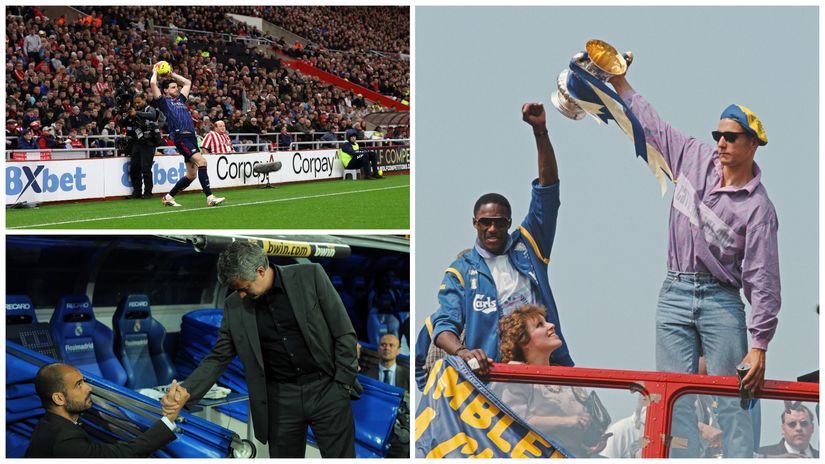
During the heated spring of 2011, when Real Madrid and Barcelona clashed four times in 18 days, reports suggested Mourinho told Bernabeu staff to let the grass grow longer ahead of the first encounter. The idea? Slow down Pep Guardiola’s trademark fast, short passing style.
It's April 2011. The Champions League, La Liga and Spanish Cup all to decide.
— IM🇵🇹 (@Iconic_Mourinho) January 3, 2025
All between Mourinho's Real Madrid and Pep's Barcelona, with Cristiano and Messi at their best.
4 games in 18 days. Fights, meltdowns, iconic moments.
Some might say football peaked here.
[A thread] pic.twitter.com/cbRxiolxNq
The match finished 1–1, but it added yet another spark to one of football’s fiercest rivalries.
Mourinho wasn’t alone in that sort of gamesmanship. His old adversary Arsene Wenger once had his own battle over pitch length — Tony Pulis claimed that Wenger even wrote to the FA complaining about how long the grass was at Stoke’s ground.
West Ham’s “mile-long” welcome
When Liverpool visited West Ham in April 2014 chasing their first league title in over two decades, they expected a tough match — but maybe not the hospitality that awaited them.
Although the Reds won 2–1 thanks to two Steven Gerrard penalties, their captain was less than impressed afterward.
"They tried everything to upset us. A hot dressing room, a dry pitch and the bus had to park a mile away," Gerrard said.
Steven Gerrard was the hero (yet again) as Liverpool beat West Ham 2-1 in 2014 🔴
— The Redmen TV (@TheRedmenTV) April 25, 2023
The #LFC captain found the net from the spot twice at Upton Park - beating current Reds' stopper Adrian on both occasions 😅pic.twitter.com/FK5FU9yX6T
West Ham’s then-chairman David Gold quickly fired back on Twitter: “Mr Gerrard, nobody forced your bus driver to park a mile away from the ground — it was his choice. If the heating is too warm, turn it down.”
Wimbledon’s foul play — literally
The Crazy Gang of the 1980s — Wimbledon’s rough-and-tumble squad — built their reputation on unsettling opponents both mentally and physically.
#OTD in 1988 Wimbledon v Liverpool FA Cup Final
— 80s&90sFootball ⚽ (@80s90sfootball) May 14, 2023
Laurie Sanchez scored the only goal as Wimbledon pulled off one of the greatest shocks in modern times
'The Crazy Gang have beaten the Culture Club'
🎙from John Motson 🙏pic.twitter.com/wbo9WoD95S
By the time they reached the 1988 FA Cup final against a dominant Liverpool side, their psychological warfare was in full swing.
Striker John Fashanu later admitted that the players didn’t shower or brush their teeth for an entire week before the final — all in the name of throwng off their opponents with their “unique” aroma.
It may have been disgusting, but it worked. Wimbledon won 1–0, lifting the FA Cup and cementing their place in football folklore as the masters of chaos.