


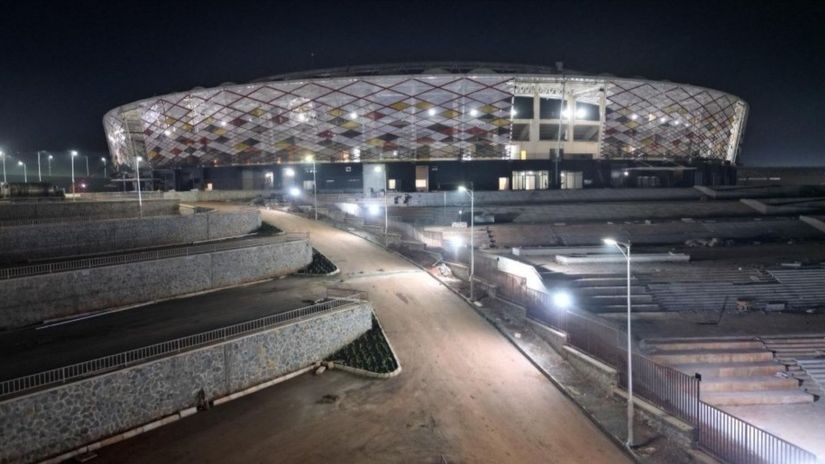
A look at Uganda's complete flagship arena rivalling Talanta Stadium [VIDEO]
.jpg)
.jpg)
.jpg)




Reading Time: 4min | Thu. 23.10.25. | 21:40
Despite the good work in the stadium, the Ugandan government is still sweating over making the facility conveniently accessible
Uganda’s flagship sporting infrastructure, Hoima City Stadium, which has been earmarked to host the 2027 Africa Cup of Nations (AFCON), has been completed two months ahead of schedule.
Follow our WhatsApp channel for more news
The project, which has been rivalling Kenya’s Talanta Sports City Stadium, has been completed in under 24 months since its construction began.
Uganda commenced the stadium's construction in July 2024 in preparation for the 2027 AFCON, which the landlocked country successfully bid alongside neighbours Kenya and Tanzania in a joint bid dubbed PAMOJA.
The stadium was originally on a 10-acre piece of land that was donated by the family of Dr James Rujumba in 2020, and thereafter, an additional 10 acres in the same estate was acquired by FUFA to increase its size to 20 acres.
Further, the Uganda National Council of Sports purchased an additional 14.9 acres, which in turn made it possible for the construction of a 20,000-seater stadium.
According to a clip on New York Traveler Vlog, the complete stadium is captured at night and showcases its magnificent finish over two months before the 31 December deadline.
In the video, the playing surface of the stadium is complete and looks mature, ready to host matches.
According to stadium standards as set by the Confederation of African Football (CAF), the length of the pitch must measure a minimum of 100m and a maximum of 110m, while the width has to measure between 64m and a maximum of 75m.
The grass height must be between 20-40 mm, while the field of play must be equipped with a drainage system to ensure it is playable even during the rainy season.
Surrounding the playing pitch, the stadium has been equipped with an Olympic-sized tartan track that is fully marked and ready for use by athletes.
In the stands, the seats have all been installed in the various sections covering both the upper and lower decks of the stands.
Just like the Moi International Sports Centre, Kasarani, the regular seats have a back rest and are coloured in the Ugandan flag colours.
The VIP sections are even better as, apart from having a back rest, they are foldable and therefore make it easier for the movement of fans within the terraces.
For the VVIP section, cushioned conference chairs have been installed in the stadium, which makes the area more luxurious as expected in order to attract the high-end fans who, in continental assignments, are largely guests of CAF and host country leadership.
Just as recommended by CAF, the VVIP section has a lounge where guests can order their favourite drinks and enjoy as they either watch or await a game.

The whole stadium has also been covered with a canopy roof that is made up of a lightweight teflon membrane, similar to the one at Kasarani.
On the steel roofing structure, stadium floodlights have already been installed and tested several times at night, albeit without matches.
In order to be suitable to host AFCON matches, which are in category four, the floodlights at Hoima have a horizontal illuminance of between 1200-2000 Lux.
In separate online videos, the various rooms in the stadium, including changing rooms, first aid and anti-doping rooms, have also been completed and are ready for use.
According to regulations, the stadium must have at least four player changing rooms with wardrobes and lockers that can accommodate at least 25 players and have at least five individual seated toilets, five showers and three urinals, among other specifications.
On the outer layer of the stadium, the curtain walls are complete and have a partially installed media facade lighting - an advanced lighting technology used to transform the exterior of a stadium to make it have dynamic displays.
.png)
Additionally, the parking lot of the stadium has also been completed, including markings and for environmental and aesthetic reasons, flowers have been planted that continue to mature day by day.
Despite the good work in the stadium, the Ugandan government is still sweating over making the facility conveniently accessible, as there is poor transport infrastructure leading to the stadium.
Nevertheless, according to Ugandan Minister of Sports Peter Ogwang, the infrastructure, especially the road network, will be improved before the 2027 AFCON.