

.jpg)
Study shows how Faith Kipyegon could achieve 'the unimaginable' in the Mile

.jpg)

.jpg)
.jpg)




Reading Time: 2min | Thu. 27.02.25. | 15:24
Drafting involves other athletes (pacers) running in formation around a designated athlete to reduce the aerodynamic drag force acting on the designated runner
A new study suggests 1500m Olympic champion and mile world record holder Faith Kipyegon could run 3:59.37, in the latter, with optimal drafting.
The research, published in the Royal Society Open Science, found that reducing aerodynamic drag with two well-placed pacers, one ahead and one behind, could allow Kipyegon to run 3.19% faster than her world record of 4:07.64 from 2023.

Using the same pacing techniques that helped Eliud Kipchoge break the two-hour marathon barrier, the study calculated that a team of elite female pacers switching out at 800m could provide enough drafting to make history.
A rotating cast of pacemakers would not make it eligible for a world record much like Kipchoge’s 1:59:40 in his 2019 time trial in Vienna.
Drafting involves other athletes (pacers) running in formation around a designated athlete to reduce the aerodynamic drag force acting on the designated runner. This allows the designated athlete to run faster at the same rate of metabolic energy consumption.
“Our overall approach was to estimate Kipyegon’s metabolic energy consumption during her mile world record performance. Then, we used empirically established relationships between horizontal resistive force, running velocity, and metabolic power to estimate how much faster she could run at the same metabolic power if the aerodynamic force was reduced via drafting. Our calculations suggest that Kipyegon could run 3:59.37 with drafting provided by one pacer in front and one in back who change out with two other pacers at 800m,” the study reads in part.
On 6 May 1954, Roger Bannister became the first human to run one mile (1609.344 m) in under four minutes (3:59.4). Shortly thereafter, Diane Leather ran a mile in 4:59.6, becoming the first female athlete to run under five minutes. Over the ensuing seven decades, the female mile record has continued to progress.
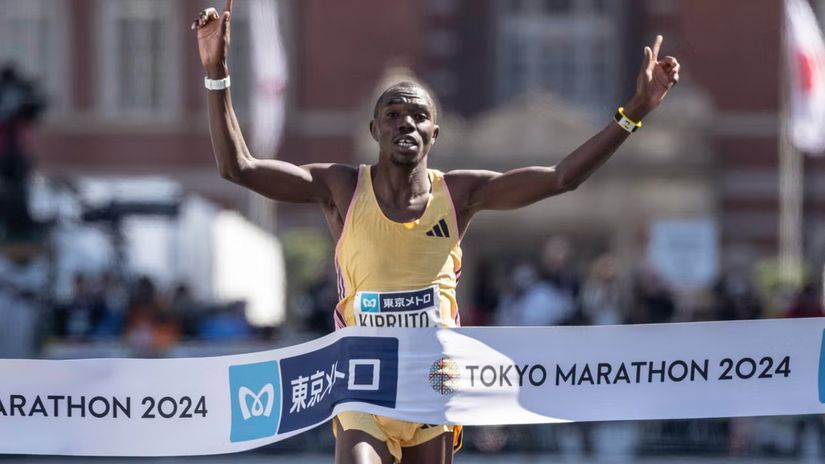
When Bannister first broke the 4-minute mile, he drafted closely behind two different pacers for more than 80% of the race. By contrast, during her world record mile race, Kipyegon ran behind pacers for just the first 900 m (56% of the race) and thereafter ran solo, with no drafting.
Further, she did not consistently run closely behind her pacers, and thus the drafting was suboptimal.
“Hopefully, Ms Kipyegon can test our prediction on the track,” the in-depth study concludes.