


How buzzing first-person-view drones are enhancing storytelling at Milano Cortina 2026

.jpg)







Reading Time: 5min | Thu. 12.02.26. | 11:45
"We use 860 cameras to cover the Games, but we use 1,800 microphones. You don't necessarily see them, because we plan for years how we're going to hide them in the snow, behind things and so on, but we pick every single piece of audio."
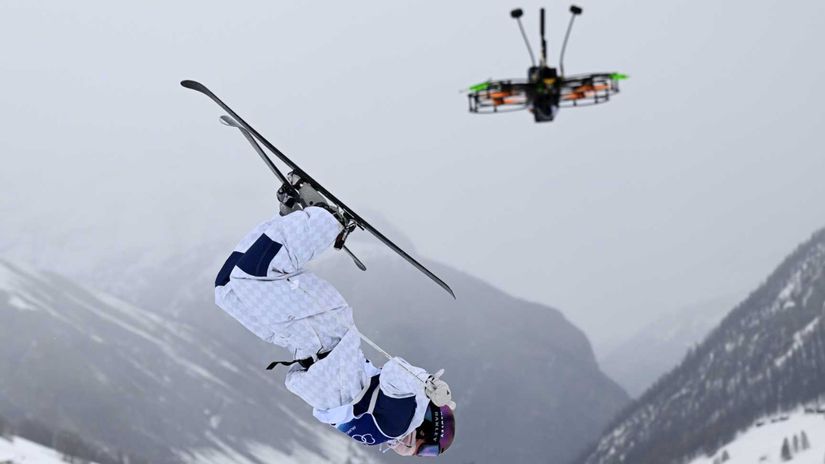
The use of drones to capture footage at the Olympics is not new, but a new kind of drone has been the talk of the town at the Milano Cortina 2026 Olympic Winter Games and its buzz is hard to miss.
This is the first-person-view or FPV drone that follows athletes closely from behind, offering immersive, close-up, unique angles to viewers watching these from home.
“We use a total of 25 drones,” said Olympic Broadcasting Services (OBS) CEO Yiannis Exarchos. “We use them in almost all sports, with the exception of ice hockey and curling.”
Follow Our WhatsApp Channel For More News
STORYTELLING: Exarchos explained that these high-tech, agile devices were incorporated to enhance the storytelling of the Games against iconic backdrops. The FPV drones cover vast distances, providing high-speed follow-cam footage at speeds up to 75 miles per hour as well as a wider view of the landscape.
“For a dedicated fan of a sport, even if they watch the coverage with two, three cameras, it will be enough, because they're interested in what happens, who wins, and so on. For us, it's not. We need to make people get attracted, get engaged with the sport.
Technology increasingly offers us a lot of opportunities, but as I constantly keep on reminding, first of all, myself, the team, and everyone, the Olympic Games are not about showcasing technology.
It is about finding the most engaging ways of telling the stories of the biggest athletes in the world in the most efficient way possible. One of the opportunities we have seen during the last years is the development in the technology of drones.”
.jpg)
Drones have been used at the Olympics since 2014 in Sochi, Russia, and amid rapid technological advancement, storytelling remains at the core of Olympic broadcasting.
“We use technological innovation only if it adds to the story that we're telling. Not just to showcase technology," said Exarchos. "Especially in the density of the Games. If we simply started flying drones around and showing random things, people would get sick of it after the first day. So for us, it only made sense if editorially it could be integrated in the story we are telling. And this is why you see in every single sport there is a very specific design of what we cover with the drones.”
Exarchos said the process to introduce the FPV drones began before the Paris 2024 Olympics.
“Since that time we had in our minds to do it. We already have in our minds more or less what we want to do in Los Angeles and where we hope technology will be at that time.”
The introduction of the FPV drones followed extensive testing and coordination with international federations, technical officials and athletes to ensure safety and effectiveness.
“We didn't want this to become a factor affecting them. We wanted this to become a factor enhancing.”
THE HUMAN FACTOR: The drone pilots were trained in the respective sports, and some of them have competitive backgrounds. “For FPV drones we have a pilot and we have a spotter sitting next to them who really guides them about any situations in the environment. Because the pilot is wearing goggles like you wear in VR," Exarchos explains.
"Now the pilots themselves are trained in the specific sport for a long time. I don't dare to say that they trained as much as the athletes, but I can tell you that they have spent many, many days and actually they have provided a lot of input about what are the best possible shots and what makes sense and what doesn't. It's interesting that some of them have this background.
.jpg)
The pilot in ski jumping, is a ski jumper himself. He is friends with all the athletes. He knows the sport inside out. He was the one actually discussing with our producers and explaining what makes sense, how it makes sense to show the jump, what is the feeling, and to replicate it."
He continues, "But the same goes for practically everyone involved in this operation. It may seem like a simple flight, but there has been a lot of preparation, years, I would say, of preparation, a lot of technical elements. You understand that all these require connectivity, safety, power redundancy.
The good thing is that we have resolved also problems of latency, so that when you cut to a drone, you do not have a delay that sometimes you have with digital equipment and RF transmitted equipment. And this is why I believe that the result is good.”
THE NOISE: Regarding the sound of drones’ rotating blades which has raised some questions, Exarchos explained: “In the coverage that OBS does for the Olympics, there is an extremely sophisticated audio plan. We use 860 cameras to cover the Games, but we use 1,800 microphones. You don't necessarily see them, because we plan for years how we're going to hide them in the snow, behind things and so on, but we pick every single piece of audio."
He elaborates more, “Now, for the athletes themselves, practically this noise cannot be heard, because especially in the sports of high speed, where you mostly hear the noise. First of all, the drone is behind them. They also have to deal with the noise from the wind, and they wear helmets. We haven't heard from any of them that that noise is an issue. I would say the issue is more for the viewers on television.
Regardless, I think that through the years this noise, with technology, will be reduced. I believe that also with AI, at some point it will be possible to reduce the capture of this noise from the microphones. But currently, if we did that, we would kill a lot of the other atmosphere that we capture in the venues, and we simply don't want to do that.”