


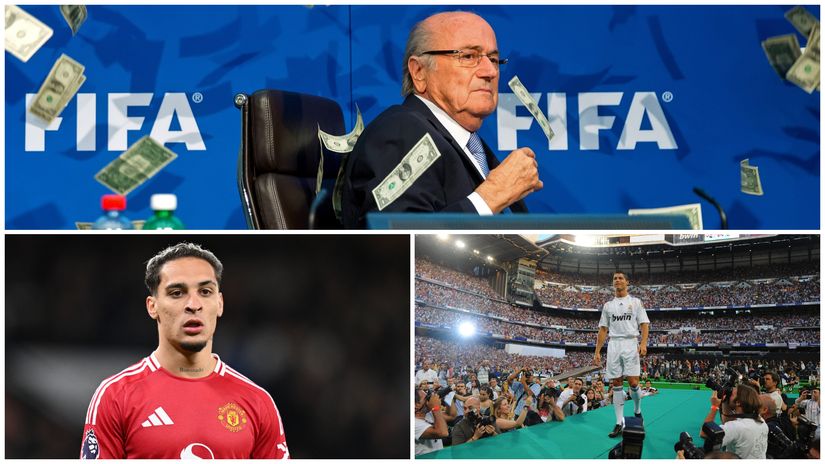
Depravity of the football transfer policy




.jpg)




Reading Time: 4min | Thu. 07.08.25. | 12:33
We are witnessing increasingly astronomical transfer fees and unbelievable figures, which makes us wonder — how was it in the past? Here's a comparison of two different eras, along with an explanation of why things have changed
Football has always evolved — in style, speed, tactics, and technology. But one of the most dramatic shifts over the past two decades has happened off the pitch, in the world of transfers. The value of players today has skyrocketed to the point where solid, promising talents now cost more than proven legends once did. It’s a transformation driven by a mix of business, branding, and booming competition.
One of the most striking examples is the recent transfer of Bryan Mbeumo to Manchester United for a reported fee of 71 million euros. Mbeumo is a talented winger who impressed with Brentford in the Premier League, but he's never been considered among the elite. Yet his price tag exceeds that of Kaka, who joined Real Madrid from AC Milan in 2009 for 67 million euros.
🚨 Manchester United confirm Bryan Mbeumo has joined from Brentford on a 5+1 deal. £65m+£6m fee.
— Ben Jacobs (@JacobsBen) July 21, 2025
🗣️ Mbeumo: “As soon as I knew there was a chance to join Manchester United, I had to take the opportunity to sign for the club of my dreams.” pic.twitter.com/GAaSg4v4au
Kaká (27) (€67M) - AC Milan to Real Madrid (2009) pic.twitter.com/rKcJKzxg7H
— Transfersthathappened (@actualtransfers) May 15, 2025
Let that sink in: Mbeumo, a player with no major titles or individual awards, was sold for more than Kaka — a Ballon d’Or winner, a Champions League champion, and one of the finest midfielders of his generation.
This comparison alone speaks volumes about how much the football market has inflated. And it’s not just Mbeumo and Kaka. In 2009, Cristiano Ronaldo, already a global superstar and Ballon d'Or winner, made a then-world-record move to Madrid for 94 million euros. In contrast, Antony, a talented but still inconsistent winger, cost 95 million euros when United signed him from Ajax in 2022.
Real Madrid signed 24 year old Cristiano Ronaldo for €94M. He recorded 451 goals and 131 assists in 438 games whilst winning 16 trophies including 4 Champions League trophies and 4 Ballon d’Ors and left to join Juventus at 33 years old for €117M.
— Madrid Xtra (@MadridXtra) June 29, 2025
Legendary. pic.twitter.com/KNNqVoaKKt
BREAKING NEWS 🚨: Antony is expected to arrive in Manchester today ahead of having a medical and finalising his £85.4m move from Ajax to Manchester United ✈️🔴 pic.twitter.com/SutyFFrGy9
— Sky Sports News (@SkySportsNews) August 29, 2022
Even defenders have felt this surge. Harry Maguire’s 87 million euros transfer to United made him more expensive than legendary defenders like Alessandro Nesta, Carles Puyol, or Rio Ferdinand, despite having achieved significantly less at the time of his transfer.
Why Has This Happened?
This isn't just about inflation in a general economic sense — it’s about how the very nature of football has changed.
First, clubs today are wealthier than ever. Thanks to billion-euro broadcasting deals, global merchandising, and the influx of ownership by super-wealthy investors and state-backed funds, clubs — especially in the Premier League — have more financial firepower. That makes it easier to spend big, and harder to negotiate bargains.
Second, there’s a clear shift in focus from proven success to future potential. Clubs are now investing in what players might become rather than what they’ve already accomplished. A 22-year-old with pace and flair is often seen as more “valuable” than a 29-year-old with a Champions League medal. The idea is that younger players can grow, be sold again, or serve the team longer — which makes them more appealing, even at outrageous prices.
Third, the role of marketing and branding has never been more important. Footballers are now global icons, followed by millions on social media, with influence far beyond the pitch. A signing isn’t just a tactical move — it’s a marketing campaign. Players with a strong online presence or "star potential" can generate attention, shirt sales, and sponsorships, making clubs more willing to overpay.
The evolution of every record transfer (1992 - 2017) 💰 pic.twitter.com/3MhVwm8Zm9
— Football Daily (@footballdaily) February 2, 2018
Finally, the globalisation of football has created a much more competitive market. There are more clubs with deep pockets now — not just the traditional giants. As a result, bidding wars have become more common, and prices get inflated quickly. If one club won’t pay 70 million, another might.
A New Era
Today, transfer fees no longer strictly reflect quality or career achievements. They’re a complex result of age, potential, marketability, and timing. That’s why we now live in an era where someone like Bryan Mbeumo can cost more than Kaka, and where average players carry price tags that once belonged to Ballon d'Or winners.
"That's an area that has to be controlled!" 🤷♂️
— The Overlap (@WeAreTheOverlap) August 5, 2025
Plenty has changed in football… but what still needs addressing? 👀 pic.twitter.com/ik3X9RYIdm
It’s not necessarily wrong — it’s just different. Football has become a global business, and like all industries, value is determined by more than just talent. But for fans who remember the days when legends came cheap by today’s standards, it’s a stark reminder of how far the game has shifted — from the sport we love to the market it has become.